
How Curiosity Fuels Reflection and Learning: Inviting Metacognition through I Wonder Projects

by Marna Winter, Associate Director, Center for the Advancement of Teaching & Learning, Elon University

“Looking at our course goals for the past semester, what lingering question do you still have? What are you still wondering about?”

Rethinking the End of the Semester

Research consistently shows that when learning experiences invite student choice and creativity, students engage more deeply and demonstrate stronger understanding (Bovill, 2020). Opportunities for autonomy and collaboration within a supportive classroom community also enhance motivation and performance. Encouraging students to reflect on their own learning processes, what psychologist John Flavell (1976) called metacognition, is another key component of meaningful learning. Structured reflection helps students connect new knowledge with prior understanding, strengthen conceptual links, and sustain curiosity.

After years of preparing junior and senior teacher candidates to meet national and state professional requirements, I was eager to work with second-year students in our foundational course, Foundations of 21st Century Teaching. This course, which introduces classroom community, unit and lesson planning, and technology integration, lays the groundwork for later methods courses. Because students must carry this knowledge into their practicum experiences and student teaching, I wanted an approach that invited deeper understanding and transfer.
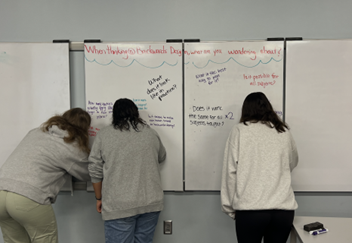
Three students writing on a white board as part of the I Wonder activity
Photo credit – M. Winter with student permission. Students engaging in a Chalkboard Splash brainstorm

To help students think beyond our course outcomes, I created the I Wonder Project. After observing students’ energy and engagement as they explored their own lingering questions, I began using the assignment in other cross-disciplinary courses, including a First-Year Seminar and an activity-based course, Joyful Living.

The I Wonder Project intentionally invites students to reflect on their learning, explore lingering questions related to course goals, and make deeper connections with the content. It is a brief yet powerful end-of-semester assignment that can be adapted across disciplines and completed in a single class period.

How the I Wonder Project Works

Step 1: Invite Reflection

I begin by revisiting the course goals as a class. I post the goals, facilitate a discussion about each of them, and briefly review what we did to address each one. This helps students make explicit connections between the experiences and their current level of understanding before I ask, “What are you still wondering about?”

Students reflect independently, using the awareness gained from reviewing the goals to generate a question that stands out to them the most. They then post their responses on a shared Padlet, Google Doc, or whiteboard, creating a visible brainstorm of curiosity that sparks connection and shared inquiry. We spend a few minutes reflecting on the major themes they notice in each other’s questions, which allows students to compare their thinking with their peers. Noticing patterns in their classmates’ questions challenges students to examine their own thinking in relation to others.

Step 2: Explore the Question

In the research phase, each student selects one question they are still wondering about. This becomes their way to follow through on the learning needs they identified. They spend about 15–20 minutes researching, drawing from class materials, readings, or quick online searches.

Step 3: Share and Learn Together

Students create a single slide to capture their question, key findings, and rationale, and share their work in small groups or with the class. This exchange allows them to deepen their own understanding while benefiting from their peers’ perspectives.

Across four semesters, this process has consistently revealed increased curiosity, ownership of learning, and appreciation for peer collaboration compared with more traditional end-of-semester activities. These steps guide students through a metacognitive cycle of noticing, evaluating, and investigating their own wonderings.

What the Data Reveal

Curious about students’ perceptions, I gathered data. Nearly half of the students connected their topics to personal experiences or well-being, suggesting that personal meaning is a powerful driver of curiosity. Many demonstrated metacognitive awareness by explaining why certain topics resonated and how prior knowledge shaped their questions. Others showed strong transfer of learning, linking their wonderings to future careers, teaching practices, or personal growth.

Others revealed strong transfer of learning, linking their questions to future careers, teaching practices, or personal growth beyond the classroom. Many students also demonstrated metacognitive thinking as they reflected on how course goals connected to their personal lives, future teaching, and professional contexts. One student noted, “It made me reflect on the overall course content and how it can be applied to my placement.” Another shared, “It made me feel like I could apply what I was learning to my own personal life.” A third explained, “This project allowed me to combine what I learned and see how applicable it is to my personal life.

These patterns demonstrate that when students have space to ponder their own lingering questions at the end of the semester, they engage meaningfully in metacognitive reflection, monitoring what they understand, evaluating what they are still wondering about, searching out responses and connections, and identifying next steps in their learning.

From Summative Assessment to Reflective Closure

Traditionally, the end-of-course assessments often emphasize performance over reflection, leaving little room for students to pause and make meaning of their learning. The I Wonder Project reframes the final week as an opportunity for metacognitive reflection and renewal. Rather than asking, “What did you memorize?” it asks, “What are you still curious about?”

At the end of each semester, I now dedicate one of our final classes to this reflective exploration. Students revisit course goals, discuss how they’ve been addressed, and then identify new directions for their learning. By reviewing the goals and evaluating their progress, students build an awareness of how their learning has unfolded and where gaps or developing interests remain. They then use that awareness to decide what they still wonder and where their learning should go next. The result is a classroom atmosphere filled not with anxiety but with energy, curiosity, and a sense of shared accomplishment.

Closing the Reflective Circle

In the final step, students complete a brief post-assignment reflection as part of my IRB-approved study. What began as a data-collection tool became an essential part of the reflective cycle. The survey prompts students to analyze their motivations, challenges, and learning patterns, transforming the project from an exploration of curiosity into an exercise in thinking about thinking.

  • Why did you choose your question?
  • How did the I Wonder Project influence your sense of ownership and engagement?
  • How did the freedom to choose impact your motivation or interest?
  • Compared to other assignments, what aspects did you find most meaningful or challenging?

This final step transforms the project from an activity about curiosity to an exercise in thinking about thinking. Students not only research their lingering questions but also analyze their motivations, challenges, and learning patterns. By naming these cognitive processes, they become more aware of how curiosity, autonomy, and reflection shape their learning experiences.

Fostering Lifelong Learning

By engaging students in structured metacognitive reflection, the I Wonder Project cultivates motivation, curiosity, and deeper understanding. Their freedom to choose topics encourages critical thinking about why certain questions matter, making explicit the connection between knowledge, identity, and purpose.

This shifts the learning from a finite performance to a continuous process. By inviting curiosity and personal relevance, the project reinforces the broader purpose of education: to foster lifelong learners who remain curious, reflective, and capable of applying their learning beyond the classroom.

As a complement to traditional assessments, the I Wonder Project offers a simple yet powerful way to end the semester with intention, inviting students to pause, make meaning, and wonder what comes next.


References

Bovill, C. (2020). Co-creating learning and teaching: Towards relational pedagogy in higher education. Routledge.

Flavell, J. H. (1976). Metacognitive aspects of problem solving. In L. B. Resnick (Ed.), The nature of intelligence (pp. 231–235). Erlbaum.


Writing as Tool to Think (Substack)

Created by Dr. Gina Burkart, the Writing as Tool to Think Substack is a free resource for anyone and everyone. It is especially intended for college educators and college students to practice using writing as tool to find success in setting goals, achieving goals, learning, engaging in metacognitive practices, better understanding themselves, finding meaning, joy, and purpose through writing. 

https://open.substack.com/pub/writingasatool/p/writing-as-a-tool-to-learn-and-think?r=50umd1&utm_campaign=post&utm_medium=web&showWelcomeOnShare=true 


Metacognition: ideas and insights from neuro and educational sciences

The authors of this article point out that “the educational and neuroscience disciplines have largely developed separately with little exchange and communication.” Their article provides useful summaries of metacognition in cognitive neuroscience research and metacognition in educational sciences research. They conclude with several useful directions for future interdisciplinary research on metacognition and how it’s developed.

Fleur, D.S., Bredeweg, B. & van den Bos, W. (2021). Metacognition: ideas and insights from neuro- and educational sciences. npj Sci. Learn. 6(13). https://doi.org/10.1038/s41539-021-00089-5 


Metacognitive Strategies and Development of Critical Thinking in Higher Education

This paper studies a metacognitive intervention to develop both critical thinking and metacognition skills. Their data “have shown that this relation is bidirectional, so that metacognition improves thinking skills and vice versa.” (P 10)

Rivas, S., Saiz, C., & Ossa, C. (2022). Metacognitive Strategies and Development of Critical Thinking in Higher Education. Frontiers in Psychology. Vol 13 (article 913219). https://doi.org/10.3389/fpsyg.2022.913219


Supporting thinking about thinking: examining the metacognition theory‑practice gap in higher education

This study investigated higher education academics’ familiarity with both aspects of metacognition, knowledge of cognition and regulation of cognition, as well as their incorporation of metacognitive supportive practices (MSPs) in their courses. The authors conclude that “despite extensive investigation of metacognition in the literature, academics are broadly unfamiliar with metacognition and did not explicitly include it in their teaching.”  This paper also includes a table summarizing MSPs grouped according to their theoretical alignment with metacognition constructs, and shares data showing the prevalence of their use.

Dennis, J. & Somerville, M. (2023). Supporting thinking about thinking: examining the metacognition theory‑practice gap in higher education. Higher Education. Vol 86: 99-117. https://doi.org/10.1007/s10734-022-00904-x


Investigating the Effects of Academic Coaching on College Students’ Metacognition

The authors “conducted this exploratory study to situate an academic coaching model within theories of SRL and to examine academic coaching’s effects on undergraduate students’ metacognitive awareness. Results from the RCT indicated that both in-person and online academic coaching increased students’ use of metacognitive skills over the course of the intervention, which is a key component to engaging in and facilitating SRL processes. Students in both treatment conditions reported that they perceived the intervention to be helpful, that they would engage in academic coaching in the future, and that they would recommend academic coaching to their peers.” (p. 199)

Howlett, M., McWilliams, M., Rademacher, K., O’Neill, J., Maitland, T., Abels, K., Demetriou, C., & Panter, A. (2021). Investigating the Effects of Academic Coaching on College Students’ Metacognition. Innovative Higher Education. Vol 46:189–204. https://doi.org/10.1007/s10755-020-09533-7


The Metacognitive Practice of Reinforcing Voice and Identity in the First-Year Writing Classroom

by Dr. Gina Burkart, Assistant Professor of First-Year Studies, Department of Liberal Arts, Clarke University

My motivations

The emergence of AI in the writing classroom has reinforced the importance of using a mirrored practice of metacognition in teaching and learning. When and why would a professor engage or not engage in the use of AI for curriculum formation? Why would a student turn to AI for writing? When could it be harmful to do so? These questions have been on my own mind for quite some time.

I have always found writing to be more than a product. It is a tool for thinking; it helps me better understand ideas and who I am and what I think about in relation to those ideas. For this reason, writing has brought me a sense of freedom, release, joy and identity. I began teaching writing to help students experience this process and never-ending journey of discovery.image shows a lined paper with a pencil on it next to a typewriter on a table

In teaching writing for the past 25 years, I have found that students come to college believing there is one way to write and to read—and that they are terrible at both reading and writing. They have fear, anger, dread, and a bit of hostility about their experiences. It has been my mission to undo all those negative messages in the first-year writing classroom. With AI whispering over their shoulder that they can conveniently solve all their writing problems and save them time—I must convince them that before they turn to AI as a collaborative tool in the process, they must first know their own voice and who they are as writers and thinkers.

AI can turn into a misleading, bad friend quickly. To disarm a bad friend and make ethical decisions, one must first know the rules, ethics, and have a solid sense of who they are, what they believe in and have a confident voice. This has reinforced my use of metacognition in the writing classroom—in my teaching, creating curriculum, and assessment practices.

Here are some of the theorists that guide me in my practices:

  • Gee (2013)—Discourse leads to a better understanding of each other​
  • Foucault (1988)—Self is formed through discursive practices​
  • Bandura (1977)—self-efficacy is formed through several factors​
    • Mastery Experiences: positive and negative​
    • Vicarious: Observation of others​
    • Verbal Persuasion: Positive Affirmations from others​
    • Physiological and Affective States: Interpretation and understanding of physical & emotional reactions to situations​
  • Marzano (2007)—3 systems of learning: Self, metacognitive, cognitive

The Classroom Activity

What does this metacognitive pedagogy look like in practice? In the Spring 2025 semester, I was more intentional about facilitating reflection in writing and creating discourse about this reflection in order to engage students in these self-reflective and social reflective discourse practices, which calls them into metacognitive awareness. For example, I began the first day of classes by reading the poems: “The Journey” by Mary Oliver and “A Way of Writing” by William Stafford. Students were then asked to free write for 10 minutes after each poem about any line of poem that triggered a thought, ideas, memory.

The free write was not about interpreting the poem or summarizing the meaning of the poem but rather about what connections they made to the poems. What was bubbled up in them by the poem? They were to write nonstop on paper—stream write—without editing themselves. I then asked them to identify themes from their free writes—ideas or words that emerged that they had not planned on or been aware of before reflecting upon the poems. I listed the themes on the whiteboard, and we talked about what the themes showed about our class identity. In so doing, students became aware of their thinking individually and collectively. They were being metacognitive. Interestingly, the two themes that most appeared in all three classes were freedom and voice.

Students described the experience as cathartic and as a release. They enjoyed the physical act of writing on paper. The experience was enjoyable and eased anxiety. This was an especially interesting discussion as the class was about to embark on reading together The Anxious Generation by Jonathan Haidt (2024), which makes the case that the use of technology has led to an epidemic of anxiety in the generation of students in my writing classroom. Could metacognitive writing and discussion of writing be a solution?

Following is a synthesis of how the theorists mentioned above guided my teaching. This simple exercise reinforced discourse as an effective way of understanding themselves and each other (Gee, 2013). It allowed self to emerge and form in the discursive practice of listening to and thinking in writing about the ideas of the poets in relation to themselves and then hearing and seeing what ideas emerged from their classmates’ free writes (Foucault, 1988). Importantly, it created self-efficacy, as the students let go of editing their ideas and writing, and in turn, found a release that led to a positive, affirming experience with their classmates where they observed and interacted with each other in discourse that was both emotional and physical (Bandura, 1977). Together, we used writing, reading, and metacognitive thought to arrive at communal understandings of self and other. The students learned about writing by reflecting on themselves, their own writing, and how it related to their classmates’ writing and the poet’s ideas expressed in their poetry (Marzano, 2007).

This first day of class experience began a writing journey that was repeated—as each class started with a 5-minute free write that reinforced the curriculum for the day and also called them to metacognitively reflect on self and other in relationship to the curriculum. Class writing workshops and assessment of writing in one-on-one, in-person conferences reinforced curriculum. They also reinforced progress toward growth rather than a perfect product. The result was a class that reported in final conferences a new sense of joy and freedom in writing and value for voice, humanity and community found through writing. Hopefully, these experiences equipped them with a strong voice and identity that helps them better respond and interact with their new friend AI.

References

Bandura, A. (1977). Self-efficacy: Toward a unifying theory of behavioral change. ​Psychological review, 84(2).​

​Foucault, M. (1988). The history of sexuality (Vol. 3): The care of the self. New York: Vintage.​

​Gee, J. (2013). Discourse v. discourse. In C. A. Chapelle (Ed.), The encyclopedia of applied linguistics. Malden, MA: Wiley- Blackwell.​

Haidt, J. (2024). The anxious generation: How the great rewiring of childhood is causing an epidemic of mental illness. New York: Penguin Press.

Marzano, R. J. (2007). The new taxonomy of educational objectives (2nd edition). Thousand Oaks, CA: Corwin Press.