
by Marna Winter, Associate Director, Center for the Advancement of Teaching & Learning, Elon University
“Looking at our course goals for the past semester, what lingering question do you still have? What are you still wondering about?”
Rethinking the End of the Semester
Research consistently shows that when learning experiences invite student choice and creativity, students engage more deeply and demonstrate stronger understanding (Bovill, 2020). Opportunities for autonomy and collaboration within a supportive classroom community also enhance motivation and performance. Encouraging students to reflect on their own learning processes, what psychologist John Flavell (1976) called metacognition, is another key component of meaningful learning. Structured reflection helps students connect new knowledge with prior understanding, strengthen conceptual links, and sustain curiosity.
After years of preparing junior and senior teacher candidates to meet national and state professional requirements, I was eager to work with second-year students in our foundational course, Foundations of 21st Century Teaching. This course, which introduces classroom community, unit and lesson planning, and technology integration, lays the groundwork for later methods courses. Because students must carry this knowledge into their practicum experiences and student teaching, I wanted an approach that invited deeper understanding and transfer.
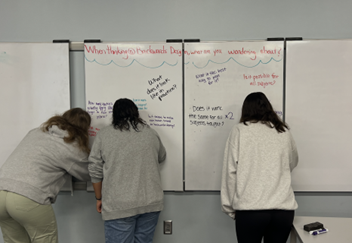
To help students think beyond our course outcomes, I created the I Wonder Project. After observing students’ energy and engagement as they explored their own lingering questions, I began using the assignment in other cross-disciplinary courses, including a First-Year Seminar and an activity-based course, Joyful Living.
The I Wonder Project intentionally invites students to reflect on their learning, explore lingering questions related to course goals, and make deeper connections with the content. It is a brief yet powerful end-of-semester assignment that can be adapted across disciplines and completed in a single class period.
How the I Wonder Project Works
Step 1: Invite Reflection
I begin by revisiting the course goals as a class. I post the goals, facilitate a discussion about each of them, and briefly review what we did to address each one. This helps students make explicit connections between the experiences and their current level of understanding before I ask, “What are you still wondering about?”
Students reflect independently, using the awareness gained from reviewing the goals to generate a question that stands out to them the most. They then post their responses on a shared Padlet, Google Doc, or whiteboard, creating a visible brainstorm of curiosity that sparks connection and shared inquiry. We spend a few minutes reflecting on the major themes they notice in each other’s questions, which allows students to compare their thinking with their peers. Noticing patterns in their classmates’ questions challenges students to examine their own thinking in relation to others.
Step 2: Explore the Question
In the research phase, each student selects one question they are still wondering about. This becomes their way to follow through on the learning needs they identified. They spend about 15–20 minutes researching, drawing from class materials, readings, or quick online searches.
Step 3: Share and Learn Together
Students create a single slide to capture their question, key findings, and rationale, and share their work in small groups or with the class. This exchange allows them to deepen their own understanding while benefiting from their peers’ perspectives.
Across four semesters, this process has consistently revealed increased curiosity, ownership of learning, and appreciation for peer collaboration compared with more traditional end-of-semester activities. These steps guide students through a metacognitive cycle of noticing, evaluating, and investigating their own wonderings.
What the Data Reveal
Curious about students’ perceptions, I gathered data. Nearly half of the students connected their topics to personal experiences or well-being, suggesting that personal meaning is a powerful driver of curiosity. Many demonstrated metacognitive awareness by explaining why certain topics resonated and how prior knowledge shaped their questions. Others showed strong transfer of learning, linking their wonderings to future careers, teaching practices, or personal growth.
Others revealed strong transfer of learning, linking their questions to future careers, teaching practices, or personal growth beyond the classroom. Many students also demonstrated metacognitive thinking as they reflected on how course goals connected to their personal lives, future teaching, and professional contexts. One student noted, “It made me reflect on the overall course content and how it can be applied to my placement.” Another shared, “It made me feel like I could apply what I was learning to my own personal life.” A third explained, “This project allowed me to combine what I learned and see how applicable it is to my personal life.”
These patterns demonstrate that when students have space to ponder their own lingering questions at the end of the semester, they engage meaningfully in metacognitive reflection, monitoring what they understand, evaluating what they are still wondering about, searching out responses and connections, and identifying next steps in their learning.
From Summative Assessment to Reflective Closure
Traditionally, the end-of-course assessments often emphasize performance over reflection, leaving little room for students to pause and make meaning of their learning. The I Wonder Project reframes the final week as an opportunity for metacognitive reflection and renewal. Rather than asking, “What did you memorize?” it asks, “What are you still curious about?”
At the end of each semester, I now dedicate one of our final classes to this reflective exploration. Students revisit course goals, discuss how they’ve been addressed, and then identify new directions for their learning. By reviewing the goals and evaluating their progress, students build an awareness of how their learning has unfolded and where gaps or developing interests remain. They then use that awareness to decide what they still wonder and where their learning should go next. The result is a classroom atmosphere filled not with anxiety but with energy, curiosity, and a sense of shared accomplishment.
Closing the Reflective Circle
In the final step, students complete a brief post-assignment reflection as part of my IRB-approved study. What began as a data-collection tool became an essential part of the reflective cycle. The survey prompts students to analyze their motivations, challenges, and learning patterns, transforming the project from an exploration of curiosity into an exercise in thinking about thinking.
- Why did you choose your question?
- How did the I Wonder Project influence your sense of ownership and engagement?
- How did the freedom to choose impact your motivation or interest?
- Compared to other assignments, what aspects did you find most meaningful or challenging?
This final step transforms the project from an activity about curiosity to an exercise in thinking about thinking. Students not only research their lingering questions but also analyze their motivations, challenges, and learning patterns. By naming these cognitive processes, they become more aware of how curiosity, autonomy, and reflection shape their learning experiences.
Fostering Lifelong Learning
By engaging students in structured metacognitive reflection, the I Wonder Project cultivates motivation, curiosity, and deeper understanding. Their freedom to choose topics encourages critical thinking about why certain questions matter, making explicit the connection between knowledge, identity, and purpose.
This shifts the learning from a finite performance to a continuous process. By inviting curiosity and personal relevance, the project reinforces the broader purpose of education: to foster lifelong learners who remain curious, reflective, and capable of applying their learning beyond the classroom.
As a complement to traditional assessments, the I Wonder Project offers a simple yet powerful way to end the semester with intention, inviting students to pause, make meaning, and wonder what comes next.
References
Bovill, C. (2020). Co-creating learning and teaching: Towards relational pedagogy in higher education. Routledge.
Flavell, J. H. (1976). Metacognitive aspects of problem solving. In L. B. Resnick (Ed.), The nature of intelligence (pp. 231–235). Erlbaum.