
Make It Stick in Cognitive Psychology

by Jennifer A. McCabe, Goucher College,
jennifer.mccabe@goucher.edu

 Downloadable


Motivation and Background: I am a cognitive psychologist with a research program focused on metacognition and applied memory in education. I decided three years ago to structure my Cognitive Psychology course around the principles described in the book, Make It Stick: The Science of Successful Learning by Brown, Roediger, and McDaniel (2014). Many memory-improvement principles are discussed in this book, including: practice retrieving new learning from memory, space out your retrieval practice, interleave the study of different problem types, elaboration, and reflection. Other topics include the fluency illusion, getting past learning styles, and developing a growth mindset. Adopting this book as required reading, and structuring the course to reflect these principles, dovetailed with my increasing commitment to prompt and support students’ metacognitive growth. I hoped that this would both enhance student learning on objective tests (in a notoriously challenging course), and also explicitly support a course learning outcome: Improve your metacognitive skills (knowing what you know, learning how to learn).

Context in which the activity or process has been used: This has been included in three sections of Cognitive Psychology, a 200-level course offered at Goucher College, a small liberal arts institution in Baltimore, Maryland. The class size is 25-30 students, and I have been teaching this course for 13 years.

Description of activity or process methods: The description of the activity is in my Cognitive Psychology syllabus (available through Project Syllabus:  http://teachpsych.org/Resources/Documents/otrp/syllabi/JM16cognitive.pdf). On the first day of class, I describe the Make It Stick” Reflection Papers. For each class period in which a chapter is assigned, students prepare and bring to class a 1-page, single-spaced reflection. Content and style is open, but they must demonstrate deep and careful thinking about the topic, and explicit connections to life experiences, habits and plans/intentions, and course material. They can also include questions and/or other personal reactions to the chapter. I note that this assignment requires elaboration and reflection, two effective learning strategies discussed in the book. Students submit 8 reflection papers during the semester (one per chapter), each worth up to 5 points. Out of a 500-point class, this assignment is worth up to 40 points (8%).

The first reflection paper is due early in the semester, typically the second week, then the subsequent seven chapters/papers are due approximately once per week. We take time in class on those days to engage in small- and large-group discussion. Most of these discussions are framed in terms of metacognition, particularly in light of research suggesting that college students do not always understand how learning works, and cannot always predict which memory strategies lead to the best retention (e.g., McCabe, 2011). I encourage them to consider their lives as learners, and how they can use information from the book to adjust their strategies.

We also talk about how this course is structured to reflect “best practice” learning strategies. For example, students take a self-graded “retrieval practice” quiz at the start of most class periods, because research shows that frequent, effortful, low-stakes, cumulative, spaced (distributed) retrieval practice: (1) produces the most durable learning; and (2) improves metacognitive accuracy of what you know. I strive to be transparent in the purpose for all course elements. In a sense, then, I see Make It Stick as a framework for the entire course – core content and topics for discussion, rationale for course design, and hopefully motivation for students to engage and feel empowered in their own learning.

Outcomes and Lessons Learned:

Since implementing this assignment, I believe that students’ knowledge about effective learning strategies has improved. They seem to enjoy the book as a required course component – on an anonymous questionnaire, 88% agreed that Make It Stick should be included in future classes. When asked whether this course had supported the learning outcome of improving metacognitive skills, 100% agreed or strongly agreed (71% strongly agreed). And when asked about one way this course has changed the way they think or behave in the world, 78% included a statement relating to metacognition. Some examples include:

“I now analyze the way I am absorbing and encoding information. I have never thought about the way I learn but now I am so grateful to accept the study strategies that work and throw away the ones that don’t.”

“It has helped me to develop a better understanding of effective study/learning strategies. Improved my metacognitive skills!”

“When I study and am overconfident in my skills, I think about metacognitive skills and test myself. This class helped me study better.”

Of course the major challenge with teaching students metacognition is that it is only half the battle to acquire knowledge about how learning works. I still struggle with motivating students to actually implement these strategies. Many are desirable difficulties (Bjork, 1994), feeling effortful and error-prone (and even frustrating) in the short term, and only showing benefits due to this initial challenge at a later time. I encourage students to use the strategies regularly, so that they become habits of mind, but I’m not convinced they consistently do so after one semester of exposure to this material. Yet the fact that they make statements such as the ones above gives me hope that they are integrating the Make It Stick ideas about metacognition into their lives.

Though this assignment has been part of a highly relevant course, Cognitive Psychology, the book Make It Stick (or selected chapters) could enhance a number of courses in and outside of psychology – as well as first-year seminars and similar courses that focus on student skill development, with the goal of teaching them how to be better learners.

References

Bjork, R. A. (1994). Memory and metamemory considerations in the training of human beings.

In J. Metcalfe & A. Shimamura (Eds.), Metacognition: Knowing about knowing (pp. 185–205). Cambridge, MA: MIT Press.

Brown, P. C., Roediger, H. L., & McDaniel, M. A. (2014). Make it stick: The science of successful learning. Cambridge, MA: The Belknap Press of Harvard University.

McCabe, J. (2011). Metacognitive awareness of learning strategies in undergraduates. Memory & Cognition, 39, 462–476. doi:10.3758/s13421-010-0035-2
Metacognitive Time Capsule Assignments for Reflection on Writing Skills

by Sarah Robinson*, U. S. Air Force Academy
sarah.robinson@usafa.edu

Downloadable

Motivations and Context:

I teach upper level Geoscience courses on Remote Sensing and Imagery Analysis—essentially using satellite imagery to study earth surface materials and processes. In addition to the course objectives on imagery analysis, I also have a course objective on communication. Specifically, I want my students to be able to construct a convincing, clear, and concise written argument that communicates their analysis choices and subsequent results. Using imagery to analyze a geospatial problem is not enough; students also need to be able to write a convincing technical summary that communicates their analysis and results to others.

One of the challenges with communication course goals is that writing is often approached with a fixed mindset (Dweck, 2007), meaning it is viewed as some innate quality that you either have or you don’t. With a fixed mindset, it simply doesn’t make sense to expend effort on writing (ex. write drafts or read feedback) because there is no clear path for improvement—it is a fixed skill regardless of effort. However, if students alternatively view writing with a growth mindset they see writing as a skill that can be improved with practice and use of specific actions/strategies to make progress. Engaging in a growth mindset requires reflection on abilities and progress (self-awareness) and identification of strategies for improvement (self-regulation). In terms of writing, this translates into effort expended on practice in multiple assignments/drafts, reflection on progress and feedback, and identification of strategies to improve future writing assignments. Course design and assignments that promote metacognition through self-awareness and self-regulation can help students develop this growth mindset. Specifically, I incorporate systematic practice, actionable feedback and a time capsule reflection assignment in my course design.

Nuts and Bolts:

Systematic Practice:

Students have 3 lab assignments and a final project where they are asked to analyze geospatial problems using imagery and then summarize their analysis and results in 1-2 paragraphs. Each lab assignment has different geospatial problems, but the writing expectations and format are the same—for each geospatial problem, students write a summary that includes an introduction to the research problem, an explanation of their analysis choices in solving the problem, and an evaluation of their results. By having the same format (but different topic) for each writing assignment, students get systematic practice in writing a convincing, clear, and concise written argument.

Actionable Feedback:

The consistent format and expectations across writing assignments allows me to use the same rubric for every assignment. While the content changes with each assignment, students can reflect on their progress by looking at their rubric scores across the semester. For the first assignment, the rubric is the same, but a multiplier is applied to the score to compensate for their initial lack of familiarity with the format. In addition to rubric scores, I provide comments in the text (students submit electronic copies of their assignments) that provide actionable feedback on how to improve the next submission. Because the comments are relevant to a future assignment, students report that they engage in self-regulation by reading and using the feedback to improve their next assignment.

Metacognitive time capsule assignment

To support student self-awareness of their progress over the semester, I created a time capsule assignment where students compare their writing on the first lab with their writing on the final project. This assignment supports student metacognitive development because it asks students to develop self-awareness by reflecting on the changes they see in their writing. As all of their submissions are digital, students have copies of all their assignments and feedback across the semester. This assignment asks students specific questions to guide their reflection and asks them to provide example text from their assignments to support their statements. I am very clear in class that they receive full credit for participating in the assignment—they are not graded on what is in their answers, only on whether they provided complete answers.

There are two keys to this assignment for effective student reflection: the “time capsule” aspect and the consistent assignment format. Having students preserve and read their actual first writing assignment is critical—this first assignment essentially captures who they were at the beginning of the semester and preserves it, as in a time capsule, to be revealed intact at the end of the semester. The time capsule aspect allows for unfiltered, direct comparison by students of their skills then vs. their skills now that is not overwritten by their experiences during the semester.

The other key component is having a consistent assignment format to make comparison easier. This assignment would not have worked as well if students were comparing writing assignments that had very different formats or expectations. By keeping the format/expectations consistent, students are better able to see and explain their progress.

Outcomes:

I had trepidations about giving this time capsule assignment the first time I used it—I honestly didn’t know how students would respond. I was pleasantly surprised to see how engaged they were—instead of just writing their answers during class time, they were sharing with each other their comparisons between their first paragraphs and what they were then able to write for their final project. Their written answers documented their reflection on the changes they saw in their technical writing skills (self-awareness) and identified writing habits that they could continue/change in future classes (self-regulation).

Lessons Learned and future directions:

This type of time capsule assignment is something that I will continue to build into my courses. The planning required to design a consistent format and preserve early assignments is a small cost for the benefits of having students develop self-awareness and self-regulation and supporting a growth mindset.

Reference

Dweck, Carol S. (2007). “Mindset: The New Psychology of Success.” New York: Ballantine Books.

* Disclaimer: The views expressed in this document are those of the authors and do not reflect the official policy or position of the U. S. Air Force, Department of Defense, or the U. S. Govt.


Meaningful Reflections for Improving Student Learning

by Ashley Welsh, Postdoctoral Teaching & Learning Fellow, Vantage College

I am a course coordinator and instructor for a science communication course (SCIE 113) for first-year science students. SCIE 113 focuses on writing, argumentation and communication in science and is part of the curriculum for an enriched, first-year experience program for international, English Language Learners. Throughout the term, students provide feedback on their peers’ writing in both face-to-face and online environments. The process of providing and receiving feedback is an important skill for students, however many students do not receive explicit instruction on how to provide or use constructive feedback (Mulder, Pearce, & Baik, 2014). In order to better understand my students’ experience with peer review, I conducted a research project to explore how their use and perceptions of peer review in their writing developed over the course of the term.

Many of the data collection methods I used to assess students’ perceptions and use of peer review in SCIE 113 this past term incorporated acts of reflection. These included in-class peer review worksheets and written reflections, small and large group discussions, an end-of-term survey about peer review, and my own researcher reflections. Periodically throughout the semester, I paired up the students and they engaged in peer review of one another’s writing. They each had a worksheet that asked them to comment on what their partner did well and how that person could improve their writing. During this activity, my teaching assistant and I interacted with the pairs and answered any potential questions. Afterwards, students independently completed written reflections about the usefulness of the peer review activity and their concerns about giving and receiving feedback. Before the class finished, we discussed students’ responses and concerns as a whole group. Students’ worksheets and written reflections, as well as classroom observations, offered insight into how my pedagogy mapped to their use of and reflections about peer review.

As of late, I have been more deliberate with designing pedagogy and activities that offer students the time and space to reflect and record their strengths and weaknesses as learners. The term reflection, is often used when discussing metacognition. As Weinert (1987) describes, metacognition involves second-order cognitions such as thoughts about thoughts or the reflections of one’s actions. With respect to metacognitive regulation, Zohar and Barzilai (2013) highlight that an individual can heighten their awareness of their strengths/weaknesses and evaluate their progress via reflection. This reflection process also plays a key role in metacognition-focused data collection as most methods require students to reflect upon how their knowledge and skills influence their learning. Providing survey responses, answering interview questions, and writing in a journal require a student to appraise their personal development and experience as a learner through reflection (Kalman, 2007; Aktruk & Sahin, 2011).

While the act of reflection is an important component of metacognition and metacognitive research, its use in the classroom also presents its own set of challenges. As educators and researchers, we must be wary of not overusing the term so that it remains meaningful to students. We must also be cautious with how often we ask students to reflect. An extensive case study by Baird and Mitchell (1987) revealed that students become fatigued if they are asked to reflect upon their learning experiences too often. Furthermore, we hope these acts of reflection will help students to meaningfully evaluate their learning, but there is no guarantee that students will move beyond simplistic or surface responses. To address these challenges in my own classroom, I attempted to design activities and assessments that favoured “not only student participation and autonomy, but also their taking responsibility for their own learning” (Planas Lladó et al., p. 593).

While I am still in the midst of analyzing my data, I noticed over the course of the semester that students became increasingly willing to complete the reflections about peer review and their writing. At the beginning of the term, students wrote rather simplistic and short responses, but by the end of the term, students’ responses contained more depth and clarity. I was surprised that students were not fatigued by or reluctant to complete the weekly reflections and discussions about peer review and that this process became part of the norm of the classroom. Students also became faster with completing their written responses, which was promising given that they were all English Language Learners. As per John Draeger (personal communication, April 27, 2016), students’ practice with these activities appears to have helped them build the stamina and muscles required for successful and meaningful outcomes. It was rewarding to observe that within class discussions and their reflections, students became better aware of their strengths and weaknesses as reviewers and writers (self-monitoring) and often talked or wrote about how they could improve their skills (self-regulation).

Based on my preliminary analysis, it seems that tying the reflection questions explicitly to the peer review process allowed for increasingly meaningful and metacognitive student responses. The inclusion of this research project within my class served as an impetus for me to carefully consider and question how my pedagogy was linked to students’ perceptions and ability to reflect upon their learning experience. I am also curious as to how I can assist students with realizing that this process of reflection can improve their skills not only in my course, but also in their education (and dare I say life). This research project has served as an impetus for me to continue to explore how I can better support students to become more metacognitive about their learning in higher education.

References

Akturk, A. O., & Sahin, I. (2011). Literature review on metacognition and its measurement. Procedia Social and Behavioral Sciences, 15, 3731-3736.

Baird, J. R., & Mitchell, I. J. (1987). Improving the quality of teaching and learning. Melbourne, Victoria: Monash University Press.

Kalman, C. S. (2007). Successful science and engineering teaching in colleges and universities. Bolton, Massachusetts: Anker Publishing Company, Inc.

Mulder, R.A., Pearce, J.M., & Baik, C. (2014). Peer review in higher education: Student perceptions before and after participation. Active Learning in Higher Education, 15(2), 157-171.

Planas Lladó, A., Feliu Soley, L., Fraguell Sansbelló, R.M., Arbat Pujolras, G., Pujol Planella, J., Roura-Pascual, N., Suñol Martínez, J.J., & Montoro Moreno, L. (2014). Student perceptions of peer assessment: An interdisciplinary study. Assessment & Evaluation in Higher Education, 39(5), 592-610.

Weinert, F. E. (1987). Introduction and overview: Metacognition and motivation as determinants of effective learning and understanding. In F. E. Weinert & R. H. Kluwe (Eds.), Metacognition, motivation, and understanding (pp. 1-16). Hillsdale, New Jersey: Lawrence Erlbaum Associates, Inc.

Zohar, A., & Barzilai, S. (2013). A review of research on metacognition in science education: Current and future directions. Studies in Science Education, 49(2), 121-169.


Learning to Write and Writing to Learn: The Intersection of Rhetoric and Metacognition

by Amy Ratto Parks, Ph.D., University of Montana

If I had to choose the frustration most commonly expressed by students about writing it is this: the rules are always changing. They say, “every teacher wants something different” and because of that belief, many of them approach writing with feelings ranging from nervous anxiety to sheer dread. It is true that any single teacher will have his or her own specific expectations and biases, but most often, what students perceive as a “rule change” has to do with different disciplinary expectations. I argue that metacognition can help students anticipate and negotiate these shifting disciplinary expectations in writing courses.

Let’s look at an example. As we approach the end of spring semester, one single student on your campus might hold in her hand three assignments for final writing projects in three different classes: literature, psychology, and geology. All three assignments might require research, synthesis of ideas, and analysis – and all might be 6-8 pages in length. If you put yourself in the student’s place for a moment, it is easy to see how she might think, “Great! I can write the same kind of paper on three different topics.” That doesn’t sound terribly unreasonable. However, each of the teachers in these classes will actually be expecting some very different things in their papers: acceptable sources of research, citation style and formatting, use of the first person or passive voice (“I conducted research” versus “research was conducted”), and the kinds of analysis are very different in these three fields. Indeed, if we compared three papers from these disciplines we would see and hear writing that appeared to have almost nothing in common.

So what is a student to do? Or, how can we help students anticipate and navigate these differences? The fields of writing studies and metacognition have some answers for us. Although the two disciplines are not commonly brought together, a close examination of the overlap in their most basic concepts can offer teachers (and students) some very useful ways to understand the disciplinary differences between writing assignments.

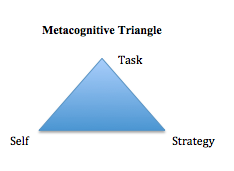
Rhetorical constructs are at the intersection of the fields of writing studies and metacognition because they offer us the most clear illustration of the overlap between the way metacognitive theorists and writing researchers conceptualize potential learning situations. Both fields begin with the basic understanding that learners need to be able to respond to novel learning situations and both fields have created terminology to abstractly describe the characteristics of those situations. Metacognitive theorists describe those learning situations as “problem-solving” situations; they say that in order for a student to negotiate the situation well, she needs to understand the relationship between herself, the task, and the strategies available for the task. The three kinds of problem-solving knowledge – self, task, and strategy knowledge – form an interdependent, triangular relationship (Flavell, 1979). All three elements are present in any problem-solving situation and a change to one of the three requires an adjustment of the other two (i.e., if the task is an assignment given to whole class, then the task will remain the same; however, since each student is different, each student will need to figure out which strategies will help him or her best accomplish the task).

Metacognitive Triangle

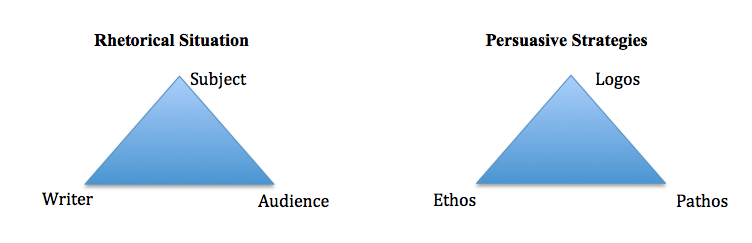
The field of writing studies describes these novel learning situations as “rhetorical situations.” Similarly, the basic framework for the rhetorical situation is comprised of three elements – the writer, the subject, and the audience – that form an interdependent triangular relationship (Rapp, 2010). Writers then make strategic persuasive choices based upon their understanding of the rhetorical situation.
Rhetorical vs Persuasive

 In order for a writer to negotiate his rhetorical situation, he must understand his own relationship to his subject and to his audience, but he also must understand the audience’s relationship to him and to the subject. Once a student understands these relationships, or understands his rhetorical situation, he can then conscientiously choose his persuasive strategies; in the best-case scenario, a student’s writing choices and persuasive strategies are based on an accurate assessment of the rhetorical situation. In writing classrooms, a student’s understanding of the rhetorical situation of his writing assignment is one pivotal factor that allows him to make appropriate writing choices.

Theorists in metacognition and writing studies both know that students must be able to understand the elements of their particular situation before choosing strategies for negotiating the situation. Writing studies theorists call this understanding the rhetorical situation while metacognitive theorists call it task knowledge, and this is where two fields come together: the rhetorical situation of a writing assignment is a particular kind of problem-solving task.

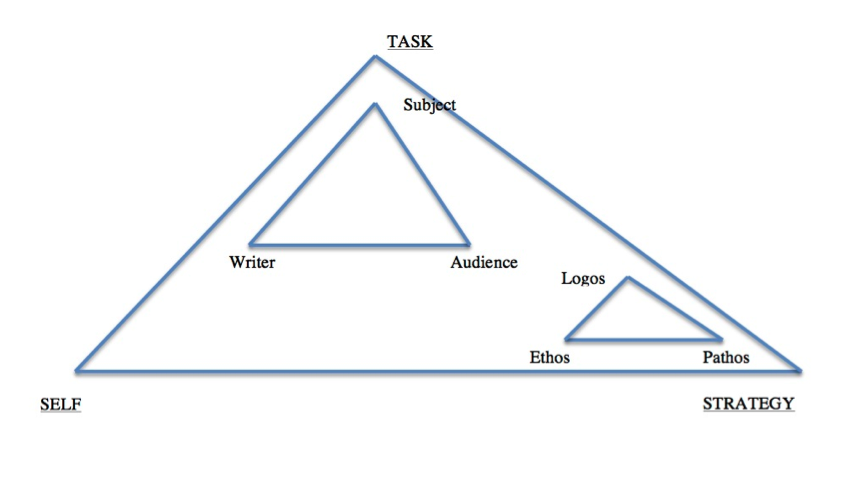
When the basic concepts of rhetoric and metacognition are brought together it is clear that the rhetorical triangle fits inside the metacognitive triangle and creates the meta-rhetorical triangle.

Meta-Rhetorical Triangle

The meta-rhetorical triangle offers a concrete illustration of the relationship between the basic theoretical frameworks in metacognition and rhetoric. The subject is aligned with the task because the subject of the writing aligns with the guiding task and the writer is aligned with the self because the writerly identity is one facet of a larger sense of self or self-knowledge. However, audience does not align with strategy because audience is the other element a writer must understand before choosing a strategy; therefore, it is in the center of the triangle rather than the right side. In the strategy corner, however, the meta-rhetorical triangle includes the three Aristotelian strategies for persuasion, logos, ethos, and pathos (Rapp, 2010). When the conceptual frameworks for rhetoric and metacognition are viewed as nested triangles this way, it is possible to see that the rhetorical situation offers specifics about how metacognitive knowledge supports a particular kind problem-solving in the writing classroom.

So let’s come back to our student who is looking at her three assignments for 6-8 papers that require research, synthesis of ideas, and analysis. Her confusion comes from the fact that although each requires a different subject, the three tasks are appear to be the same. However, the audience for each is different, and although she, as the writer, is the same person, her relationship to each of the three subjects will be different, and she will bring different interests, abilities, and challenges to each situation. Finally, each assignment will require different strategies for success. For each assignment, she will have to figure out whether or not personal opinion is appropriate, whether or not she needs recent research, and – maybe the most difficult for students – she will have to use three entirely different styles of formatting and citation (MLA, APA, and GSA). Should she add a cover page? Page numbers? An abstract? Is it OK to use footnotes?

These are big hurdles for students to clear when writing in various disciplines. Unfortunately, most faculty are so immersed in our own fields that we come to see these writing choices as obvious and “simple.” Understanding the way metacognitive concepts relate to rhetorical situations can help students generalize their metacognitive knowledge beyond individual, specific writing situations, and potentially reduce confusion and improve their ability to ask pointed questions that will help them choose appropriate writing strategies. As teachers, the meta-rhetorical triangle can help us offer the kinds of assignment details students really need in order to succeed in our classes. It can also help us remember the kinds of challenges students face so that we can respond to their missteps not with irritation, but with compassion and patience.

References

Flavell, J.H. (1979). Metacognition and cognitive monitoring: A new era cognitive development inquiry. American Psychologist, 34, 906-911.

Rapp, C. (2010). Aristotle’s Rhetoric. In E. Zalta (Ed.), The stanford encyclopedia of

philosophy. Retrieved from http://plato.stanford.edu/archives/spr2010/entries/aristotle-rhetoric/


Negotiating Chaos: Metacognition in the First-Year Writing Classroom

by Amy Ratto Parks, Composition Coordinator/Interim Director of Composition, University of Montana

“Life moves pretty fast. If you don’t stop and look around once in a while, you could miss it.” John Hughes, Ferris Bueller’s Day Off

Although the movie Ferris Bueller’s Day Off (Hughes, 1986) debuted long before our current first-year college students were born, the combined sentiment of the film remains relevant to them. If we combined Ferris’ sense of exuberant freedom with Cameron’s grave awareness of personal responsibility, and added Sloane’s blasé ennui we might see an accurate portrait of a typical first-year student’s internal landscape. Many of our students are thrilled to have broken out of the confines of high school but are worried about not being able to succeed in college, so they arrive in our classrooms slumped over their phones or behind computer screens, trying to seem coolly disengaged.

The life of the traditional first-year student is rife with negotiations against chaos. Even if we remove the non-academic adjustments of living away from home, their lives are full of confusion. All students, even the most successful, will likely find their learning identities challenged: what if all of their previous academic problem-solving strategies are inadequate for the new set of college-level tasks?

In the first-year writing classroom, we see vivid examples of this adjustment period play out every year. Metacognitive activities like critical reflective writing help students orient themselves because they require students to pause, assess the task at hand, and assess their strategies for meeting the demands of the task. Writing studies researchers know that reflection benefits writers (Yancey, 1998) and portfolio assessment, common in first-year program across the country, emphasizes reflection as a major component of the course (Reynolds & Rice, 2006). In addition, outcomes written by influential educational bodies such as National Council of Teacher’s of English (ncte.org), The Common Core State Standards Initiative (corestandards.org), and Council of Writing Program Administrators (wpacouncil.org) emphasize the importance of metacognitive skills and demonstrate a shared belief in its importance.

But students aren’t necessarily on board. It is the rare student who has engaged in critical reflection in the academic setting. Instead, many aren’t sure how to handle it. Is it busy work from the teacher? Are they supposed to reveal their deep, inner feelings or is it a cursory overview? Is it going to be graded? What if they give a “wrong” reflection? And, according to one group of students I had, “isn’t this, like, for junior high kids?” In this last question we again see the developing learner identity. The students were essentially wondering, “does this reflective work make us little kids or grown ups?”

If we want new college students to engage in the kind of reflective work that will help them develop transferable metacognitive skills, we need to be thoughtful about how we integrate it into the coursework. Intentionality is important because there are a number of ways teachers might accidentally perpetuate these student mindsets. In order to get the most from reflective activities in class, keep the following ideas in mind:

  1. Talk openly with students about metacognition. If we want students to become aware of their learning, then the first thing to do is draw their attention to it. We should explain to students why they might care about metacognitive skills, as well as the benefits of investing themselves in the work. If we explain that reflection is one kind of metacognitive activity that helps us retrieve, sort, and choose problem-solving strategies, then reflection ceases to be “junior high” work and instead becomes a scholarly, collegiate behavior.
  2. Design very specific reflective prompts. When in doubt, err on the side of more structure. Questions like “what did you think about the writing assignment” seem like they would open the door to many responses; actually they allow students to answer without critically examining their writing or research decisions. Instead, design prompts that require students to critically consider their work. For example, “Describe one writing choice you made in this essay. What was the impact of your decision?”
  3. Integrate reflection throughout the semester. Ask students to reflect mid-way through the processes of drafting, research, and writing. If we wait until they finish an essay they learn that reflection is simply a concluding activity. If they reflect mid-process they become aware of their ability to assess and revise their strategies more than once. Also, reflection is a metacognitive habit of mind (Tarricone, 2011; Yancey, 1998) and habits only come to us through repeated activity.

These three strategies are a very basic beginning to integrating metacognitive activities into a curriculum. Not only do they help students evaluate the effectiveness of their attempts at problem solving, but they can also direct the students’ attention toward the strategies they’ve already brought to the class, thereby creating a sense of control over their learning. In the first-year writing classroom, where students are distracted and worried about life circumstance and learner identity, the sense of control gained from metacognitive work is especially important.


References

Chinich, M. (Producer), & Hughes, J.H. (Director). (1986). Ferris Beuller’s day off.[Motion picture]. USA: Paramount Pictures.

Reynolds, N., & Rice, R. (2006). Portfolio teaching: A guide to instructors. Boston, MA: Bedford St, Martin’s.

Tarricone, P. (2011). The taxonomy of metacognition. New York: Psychology Press.

Yancey, K.B. (1998). Reflection in the writing classroom. Logan: Utah State University Press.

(2013). First-year writing: What good does it do? Retrieved from http://www.ncte.org/library/nctefiles/resources/journals/cc/0232-nov2013/cc0232policy.pdf

(2014). Frameworks for success in postsecondary writing. Retrieved from http://wpacouncil.org/framework

(2014). English language arts standards. Retrieved from http://www.corestandards.org/ELA-Literacy/introduction/key-design-consideration/