
A ‘New Ear’ for Student Writers: Building Awareness of Audience

by Michael Young, Robert Morris University

 Downloadable

Motivation and Background:

A fundamental hurdle for most inexperienced writers is gaining a sense of their audience, and how a different consciousness may interpret the words, the organization, and the presentation that they (the writers) use to share ideas. It is different than knowing rules, techniques, or traditions of writing. It requires more than knowledge of the topic about which they are writing. Writers must be aware of their own individual thinking, their own choices, their motivations, and how these could be interpreted or misinterpreted by other people’s ways of thinking. This need for awareness of their own thoughts that could then support their writing efforts, i.e. metacognitive writing, led me to develop a new pedagogical process for the writing classroom that uses active presentations by others to convey audience interpretation.

I used this process for three years in creative writing courses, partially because students were already pursuing genres that often are interpreted orally, but believe it could be applicable to any writing course, especially with the following course characteristics: 1) upper division/at least sophomore level so the students are already somewhat experienced collegiate writers and 2) class size is small, ideally 20 or fewer students. No special materials, other than imagination and the means to convey ideas, are needed for the in-class exercises.

Nuts and Bolts:

This pedagogical process has several steps. To first prepare the students and get them thinking about how an audience might interpret their work, the students are given an initial survey on their then-current process of writing and concept of their potential audience. Consistently, three out of five agreed that they had a “mental picture” of their reader, but it was often no further developed than their college peers or even themselves. Most could not describe their readers any further and some said they had not considered a concept of a readership. Perhaps, for them, they had written only and ever with the teacher, and so a grade, in mind.

The second step involves having canonical examples of their genre, fiction or poetry, interpreted by others. During this step those others give a presentation / reading of the work in a manner that conveys their interpretation of the writing. Those others can be classmates or a more external audience. For example, the first two years I used this process, the others were members of the Forensics Team from the University of Nebraska-Lincoln, then led by Professor Ann Burnett.

A third step, which has evolved over the years, was to have others present the students’ own writing back to them. This third step was implemented as a cycle. The students wrote their piece (either individually or as a group) and then gave it to others (classmates or external individuals) for interpretation with no additional input from the writers. The presenters would convey their interpretation, which then could be used by the writers to guide their revisions based on a better understanding of possible audience interpretation. If revisions were made, then the cycle of interpretation could be repeated.

Outcomes:

When this was done at the University of Nebraska-Lincoln, in a project funded by a grant from the university’s Teaching Council, 80% of the collaborative groups elected to revise their texts after hearing them interpreted. They noted the experience of hearing their stories being told by someone else, someone who was sharing their own understandings and insights into the words, heightened an awareness of qualities like the “flow and rhythm” of words or of “trying to make a picture in my head”, and an overall greater attention to what their drafts were able to communicate. For example, the potential hollowness of easy clichés might not have occurred to the writers or a lack of descriptions they had had in mind but which were not articulated were now more evident. Further, the majority of the class reported being much more aware of their own thinking (an aspect of metacognition) and the thinking of others.

By hearing, and sometimes seeing by the use of movements, how another person re-created the writer’s intentions, each writer had the opportunity to perceive how their audience understood what had been written down – in a way, to hear their own thinking – and to questions themselves. Is that what they had wanted someone else to feel, to think or had their expression fallen short of their conception? In other words, the process allowed them to “hear it (their work) with a ‘new ear’” and some of them realized they “should have found another way to get that (sic) message across.” That “new ear”, hopefully, was them more carefully listening to and questioning their own thoughts, i.e. being metacognitive about their own writing.


Participatory Pedagogy: Inviting Student Metacognition

by Nicola Simmons, Brock University, nsimmons@brocku.ca  Downloadable

Background

I teach higher and adult education, including adult developmental psychology, and like to invite my students to be aware of their cognitive processes. I see this as central to being an adult learner. One strategy I have developed is engaging students in creating course outcomes and content. I hope to help students become more aware of, more involved in, and better assessors of their own learning; in short, to examine their learning through a metacognitive lens.

This example is from a Masters of Education class, Exploring Approaches to Professional Development. The class is typically quite small (up to 20 students) but I have used it in groups of 50 students at the undergraduate level as well. 

The Approach 

The course follows Siemens’ (1984) participatory pedagogy (see syllabus excerpt) to invite students to co-construct the course process, including choosing course readings and creating grading rubrics:

As Biggs (2011) notes, student course co-ownership helps engage students in deep learning; it also builds their awareness of their learning processes. The first assignment, for example, asked them to:

Articulate your intended learning during this course, including a focus for personal and professional development. What will your development focus be? What will you do to realize your plan?

This engages students metacognitively as they take responsibility for their learning path and prepares them for the final assignment, a reflective ‘portfolio,’ in which they synthesize their learning over the term:

Create a creative and critical summary of your changing perspectives and reflections throughout the course, integrating readings (both assigned and others). Discuss your key learning, referring to course and outside experiences. Exemplary projects demonstrate critical analysis, synthesis, and self-evaluation. Can be any format (paper, song, performance, art; format negotiable). Addresses:

  • What theories help you?
  • What have you learned?
  • How can you use that?
  • How have you changed?
  • How do you know?

Each of these prompts invites consideration of the learning and development process and supports students in acquiring habits of mind that will allow them to approach future courses with a metacognitive lens. This has also led to their growth as scholars: One year, many of the students engaged in a self-study that included conducting a literature review and creating questions to guide our reflections. The result of that work was several conference presentations and a peer-reviewed paper (Simmons, Barnard, & Fennema, 2011) that outlined the transformative learning resulting from the student co-constructed course.

What was fascinating to me were the ways the course process built not only students’ metacognition about their learning, but also about their teaching. One wrote

I told my colleagues the story of this course and they were moved to consider new ways of doing culminating projects. Why isn’t there more choice? Why do we tell students what they must produce to demonstrate their own learning? Why don’t we add the additional layer of asking students to find the best way to demonstrate their learning?

Outcomes and Lessons Learned

Developing metacognition is not a pain-free process! One student described the transformation during the process from fear to increased confidence.

Activities were out of my comfort zone and there were times that I struggled with the unknown … I was able to see the value once I moved beyond the frozen fear of uncertainty to ask myself “What did I want to gain from this course? How did I learn when pushed out of my comfort zone?” I had to be transformed into a student who was open to this new concept and new territory for learning…[where] mistakes … would not be judged but instead used as stepping stones toward learning.

Instructors should be mindful of the importance of support throughout the process. Just as the students are invited to be metacognitive about their processes, it helps if the instructor is transparently metacognitive about the overall course path. For me that looked like saying things like “this may be new for you, but I’d like you to consider trying it” and reassuring them that discomfort was a sign they were onto something good!

The course format continues to unsettle students but also transform them into metacognitive learners, and I finish with one student’s illustrative words:

I remember thinking at the time that the final project was the most difficult task that I had encountered … I really had to ponder … how my journey through the course could be effectively captured and conveyed … It continues to personify my journey through work/life, the choices we make when we meet resistance or the paths we take … how we travel the road is for our choosing.

References

Biggs, J. B., & Tang, C. (2011). Teaching for quality learning at the university: What the student does. Maidenhead, UK: Society for Research into Higher Education & Open University Press.

Flavell, J. H. (1979). Metacognition and cognitive monitoring: A new area of cognitive–developmental inquiry. American Psychologist, 34(10), 906-911.

Siemens, G. (2008). New structures and spaces of learning: The systemic impact of connective knowledge, connectivism, and networked learning. Paper Presented for Universidade do Minho, Encontro sobre Web 2.0, Braga, Portugal, October 10. Available online at http://elearnspace.org/Articles/systemic_impact.htm

Simmons, N., Barnard, M., & Fennema, W. (2011). Participatory pedagogy: A compass for transformative learning? Collected Essays on Learning and Teaching, 4.


Make It Stick in Cognitive Psychology

by Jennifer A. McCabe, Goucher College,
jennifer.mccabe@goucher.edu

 Downloadable


Motivation and Background: I am a cognitive psychologist with a research program focused on metacognition and applied memory in education. I decided three years ago to structure my Cognitive Psychology course around the principles described in the book, Make It Stick: The Science of Successful Learning by Brown, Roediger, and McDaniel (2014). Many memory-improvement principles are discussed in this book, including: practice retrieving new learning from memory, space out your retrieval practice, interleave the study of different problem types, elaboration, and reflection. Other topics include the fluency illusion, getting past learning styles, and developing a growth mindset. Adopting this book as required reading, and structuring the course to reflect these principles, dovetailed with my increasing commitment to prompt and support students’ metacognitive growth. I hoped that this would both enhance student learning on objective tests (in a notoriously challenging course), and also explicitly support a course learning outcome: Improve your metacognitive skills (knowing what you know, learning how to learn).

Context in which the activity or process has been used: This has been included in three sections of Cognitive Psychology, a 200-level course offered at Goucher College, a small liberal arts institution in Baltimore, Maryland. The class size is 25-30 students, and I have been teaching this course for 13 years.

Description of activity or process methods: The description of the activity is in my Cognitive Psychology syllabus (available through Project Syllabus:  http://teachpsych.org/Resources/Documents/otrp/syllabi/JM16cognitive.pdf). On the first day of class, I describe the Make It Stick” Reflection Papers. For each class period in which a chapter is assigned, students prepare and bring to class a 1-page, single-spaced reflection. Content and style is open, but they must demonstrate deep and careful thinking about the topic, and explicit connections to life experiences, habits and plans/intentions, and course material. They can also include questions and/or other personal reactions to the chapter. I note that this assignment requires elaboration and reflection, two effective learning strategies discussed in the book. Students submit 8 reflection papers during the semester (one per chapter), each worth up to 5 points. Out of a 500-point class, this assignment is worth up to 40 points (8%).

The first reflection paper is due early in the semester, typically the second week, then the subsequent seven chapters/papers are due approximately once per week. We take time in class on those days to engage in small- and large-group discussion. Most of these discussions are framed in terms of metacognition, particularly in light of research suggesting that college students do not always understand how learning works, and cannot always predict which memory strategies lead to the best retention (e.g., McCabe, 2011). I encourage them to consider their lives as learners, and how they can use information from the book to adjust their strategies.

We also talk about how this course is structured to reflect “best practice” learning strategies. For example, students take a self-graded “retrieval practice” quiz at the start of most class periods, because research shows that frequent, effortful, low-stakes, cumulative, spaced (distributed) retrieval practice: (1) produces the most durable learning; and (2) improves metacognitive accuracy of what you know. I strive to be transparent in the purpose for all course elements. In a sense, then, I see Make It Stick as a framework for the entire course – core content and topics for discussion, rationale for course design, and hopefully motivation for students to engage and feel empowered in their own learning.

Outcomes and Lessons Learned:

Since implementing this assignment, I believe that students’ knowledge about effective learning strategies has improved. They seem to enjoy the book as a required course component – on an anonymous questionnaire, 88% agreed that Make It Stick should be included in future classes. When asked whether this course had supported the learning outcome of improving metacognitive skills, 100% agreed or strongly agreed (71% strongly agreed). And when asked about one way this course has changed the way they think or behave in the world, 78% included a statement relating to metacognition. Some examples include:

“I now analyze the way I am absorbing and encoding information. I have never thought about the way I learn but now I am so grateful to accept the study strategies that work and throw away the ones that don’t.”

“It has helped me to develop a better understanding of effective study/learning strategies. Improved my metacognitive skills!”

“When I study and am overconfident in my skills, I think about metacognitive skills and test myself. This class helped me study better.”

Of course the major challenge with teaching students metacognition is that it is only half the battle to acquire knowledge about how learning works. I still struggle with motivating students to actually implement these strategies. Many are desirable difficulties (Bjork, 1994), feeling effortful and error-prone (and even frustrating) in the short term, and only showing benefits due to this initial challenge at a later time. I encourage students to use the strategies regularly, so that they become habits of mind, but I’m not convinced they consistently do so after one semester of exposure to this material. Yet the fact that they make statements such as the ones above gives me hope that they are integrating the Make It Stick ideas about metacognition into their lives.

Though this assignment has been part of a highly relevant course, Cognitive Psychology, the book Make It Stick (or selected chapters) could enhance a number of courses in and outside of psychology – as well as first-year seminars and similar courses that focus on student skill development, with the goal of teaching them how to be better learners.

References

Bjork, R. A. (1994). Memory and metamemory considerations in the training of human beings.

In J. Metcalfe & A. Shimamura (Eds.), Metacognition: Knowing about knowing (pp. 185–205). Cambridge, MA: MIT Press.

Brown, P. C., Roediger, H. L., & McDaniel, M. A. (2014). Make it stick: The science of successful learning. Cambridge, MA: The Belknap Press of Harvard University.

McCabe, J. (2011). Metacognitive awareness of learning strategies in undergraduates. Memory & Cognition, 39, 462–476. doi:10.3758/s13421-010-0035-2


Utilizing a Metacognition Chart for Exam Review and Metacognitive Skill Development

by Dana Melone, Cedar Rapids Kennedy High School

 Downloadable

Motivation and Context:

I teach AP Psychology at a Kennedy High School in Cedar Rapids, Iowa. My students range in age from 15-18 years old. They also come into my classroom with a variety of grade point averages ranging from below a 2.0 to above a 4.0. While some students have excellent, note taking and study skills as well an understanding of what they need to study, I find that most of my students (even the top ones) tend to try to study everything and get overwhelmed. They also do not utilize review time to their advantage.

At the same time my students love review games and in class review time. However, for years I was hesitant to play them or give them time to review in class because they would be so actively engaged in the game or review activity that they would not take the time to consider what they knew and what they did not know, and how this should effect their studying (i.e. practice metacognition about their learning). I wanted to engage them in demonstrations and games but I also wanted them to use those activities to guide their studying and develop effective learning strategies that could be used beyond my course. In response to this dilemma, I developed the metacognitive prompt chart below.

Nuts and Bolts:

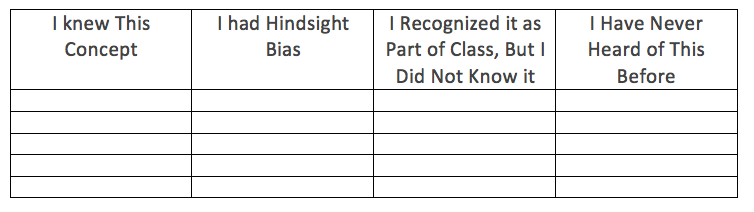
In order to help students gauge how much they know, I have started requiring them to complete the metacognitive chart as they are reviewing in class or playing a review game I have also pointed out that they can use the chart even when they are working on current content. The chart consists of 4 columns that help students categorize their understanding of the concepts.

Students use the chart by putting the concept names in the column that best describes their understanding of each concept as we move through review activities or games. There are also two questions at the bottom that ask them about the focus of their studying and patterns they have seen over time. In the end, they have a chart that allows them in one glance to know what they need to study and what they have knowledge of.

  1. What concepts need to be the focus of your studying? How will you make sure you are studying them actively?
  2. Look at your past charts, what concepts seem to remain a problem? How will you address this?

My students have this chart out any time we are going over previously learned content or reviewing (multiple times a week). I encourage my students to re-examine their charts once a week to look for patterns over time and reflect on what they need to get help with or review. I also encourage them to combine any charts as we near assessments that are cumulative. Multiple times a month I collect the sheets and can visibly see areas that all my students are struggling. I have been able to use it for my own personal metacognition in planning review, re-teaching, and remediation times.

Outcomes:

This chart has proven its effectiveness on many levels. Students have been able to visibly see the areas that they need improvement in and should focus on. They are also able to examine these sheets over time to see patterns in the content that they are struggling with and doing well with. An unintended outcome has been the ability to use it as the teacher for ongoing formative assessment of my classes.


Promoting Metacognition with Retrieval Practice in Five Ateps

by Blake Harvard, James Clemens High School

 Downloadable


Motivation for Activity

I am very lucky to work at a high school with students who are quite focused and, from the standpoint of intelligence, very gifted.   This does not make them great learners though. I realize a lot of my students clearly benefit from being able to memorize information. This may work in high school, where assessments are given sometimes daily. In college, however, this will not work. Assessment of material may consist of a midterm and a final. As a teacher who wants to better prepare my students for a lifetime of learning, I am motivated to introduce and cultivate learning strategies that focus on this personal growth and better understanding of their own learning through specific exercises promoting metacognition.

Context for Activity

I use this activity with my high school AP Psychology classes. These classes average about 30 students. Although my situation is quite specific, I believe this activity can easily be accommodated to fit most class sizes in almost all disciplines of study.

Description of Activity

Let me put all the cards out on the table: I am a big believer in using researched/proven learning strategies promoting metacognition to improve retention of classroom material. I have applied strategies in my high school Advanced Placement Psychology classes and seen notable improvements in three areas:

  • Test scores
  • Study habits
  • Student’s understanding of their learning

Improvement in test scores is important for many reasons and ultimately describes an overall level of understanding.  While I am thrilled to see my mean test score increase and standard deviation shrink a bit, that is not what I’m most excited about when lauding learning strategies.  I am far happier with the student growth with respect to their study habits and metacognition about their learning.  While I instruct highly intelligent adolescents, most of my students do not enter my room as great learners.  They are merely great memorizers.  There’s nothing inherently wrong with that, but it becomes much more difficult to just memorize your way through college and most of my students (80% to 90%) will attend university.

In particular, one learning strategy that I believe to be the most effective is retrieval practice.  The Learning Scientists provide a great overview of the strategy.  Basically, the idea is to attempt to retrieve information from your memory a bit after it’s been presented to you.  This can be done minutes, hours, or days later, and can be seen in many forms:  multiple-choice or matching questions, essays,. I have written before on the topic of retrieval practice and its impact on my classroom.  Today, I want to focus on how I promote metacognition through the use of retrieval practice in my classroom.

Usually the day after a lesson, I use these steps to practice retrieval of the information:

  1. Provide questions or a prompt.  Since I am preparing my students for an AP exam in May, I usually provide AP style questions (no more than 7). By ‘AP style’, I mean, either multiple-choice questions with five possible answers or an essay prompt requiring students use terms or concepts from the previous lesson to successfully relate their knowledge to a given scenario.
  2. Answer using only their brain.  This step starts to break their habit of asking those around them for help or looking at their notes/the internet for assistance.  In my opinion, this step is the most important aspect of retrieval practice.  They are forced to attempt to retrieve material as they practice answering test questions, which is the process in which they will have to engage during the actual test. A second benefit is that this practice can help to reduce test anxiety.  A lot of students shy away from this step because it can be difficult or because it highlights flaws in their learning, but I tell my students it’s definitely better to struggle with the material now than on the test.  If the test is the first time a student is presented with material in a way that utilizes the use of retrieval practice, we’ve all probably failed.
  3. Evaluate their answers.  How many answers are they very confident with?  How many answers are simply guesses?  I want students to understand that if they just guessed and answered correctly, they still don’t know the answer, they just got lucky.  Sometimes I’ll have my students delineate, by using a different color pen on their paper, answers they are confident with and those they are not.  This helps them to visualize their pre-grade understanding.
  4. Compare/contrast answers with neighbors.  I instruct the students to have a conversation; debate any discrepancies.  At this point, if they can thoughtfully discuss answers they probably have a decent grasp of the information and have taken time to reflect on their learning; specifically where their may be holes in their learning of the material or with what they thought they knew, but may have been mislead.
  5. Grade their paper.  After students grade their paper I want them thinking about the following questions that really allow the students to practice their metacognition and regulate/reinforce their study habits for future practice.

a. Does my grade reflect my knowledge?

b. Am I happy with my grade?

c. If no to either of the above questions, what strategies can I utilize to successfully retain the material?  At this point, many students incorrectly believe that their understanding of material is complete…for better or worse.  You can almost see them thinking either “Oh well, I just don’t know this” or “I scored well, I must know this”.  I attempt to impress upon my students that use of other strategies, like spaced practice and dual coding, will further aid to improve and solidify retention of the material.

d. If yes to the above questions, I ask students to reflect on what work they put in to remember this material so they can plan to use that strategy again for future learning. This step also helps reinforce that they should focus on learning strategies, not just guessing / luck.

Reflection

After many semesters of working with students, I have come to believe that metacognition and reflection on study habits/strategies is of foundational importance.  One of the goals I have for the students in my class, over the course of a semester, is these learning strategies become their norm for studying.  It’s not something extra, it is what they do to practice and learn.  Without the reflection piece of using retrieval practice and other learning strategies, it is hard for high school students to examine their study/practice growth. While walking the students through these five steps may seem a little laborious, the explicitness of the instructions seems to work well to increase their awareness of their own learning shape their behaviors toward more effective practices.

It is often quite difficult to convince teenagers their study/practice habits, that usually rely on simple memorization, will more than likely not be successful at college.  They need to see results from their added efforts.  Using these five steps, I have witnessed student’s grades improve and study/practice habits change for the better.  As a teacher, I’m not sure it gets any better…improving a student’s learning and making them more successful.  It’s why we get paid the big bucks.  🙂

References

Learn How to Study Using…Retrieval Practice, The Learning Scientists, www.learningscientists.org

Retrieval Practice in the High School Classroom, The Effortful Educator, www.effortfuleducator.com

Learn How to Study Using…Spaced Practice, The Learning Scientists, www.learningscientists.org

Learn How to Study Using…Dual Coding, The Learning Scientists, www.learningscientists.org


A Project-Based Method to Help Students Practice Study Strategies in an Authentic Context

by Hillary Steiner, Kennesaw State University

 Downloadable

Motivations and Context: Success in college requires the development of self-regulated learning strategies that move beyond high school skills, but teaching these strategies can be challenging. I teach a first-year seminar at a large comprehensive university that includes helping students develop college-level studying and time management skills among its goals. Knowing that students would be more likely to value these skills (and later, transfer these skills) if they were situated in context, I developed an assignment that requires students to practice self-regulated learning strategies—active reading, management of study time and achievement goals, proactive interaction with faculty, metacognitive reflection, and more—within the context of a student-selected course.

Assignment: In the Strategy Project assignment, students learn time management, communication, and study strategies in the process of preparing for an actual test. Students then demonstrate that learning by submitting their test preparation activities as part of a graded project in the first-year seminar.

First, students choose a test in another course that they find challenging. Then, they complete a contract, in consultation with their first-year seminar instructor, that indicates their individualized due dates and studying plans based on their chosen test. Students also write a pre-project reflection paper discussing their current approaches to studying and time management.

Next, the students complete a “professor interaction” activity where they visit the instructor of the chosen course to discuss a previous test or quiz, if applicable, and ask for advice about achieving success in that particular course. This portion of the project helps first-year students become comfortable interacting with their instructors and reinforces help-seeking behaviors. After this meeting, students develop a plan of study that outlines the strategies they will use to study for the test. This activity encourages effective time management and allows students to experience the benefit of study time that is distributed over several days.

Finally, the largest portion of the project requires students to complete a variety of metacognitive strategies such as textbook annotation, self-quizzing, concept-mapping, etc. Providing choices in strategies allows students to demonstrate metacognition by effectively matching studying techniques to their chosen test. After the test is graded and returned, students again complete a metacognitive reflection on the outcome of their studying habits in a short informal paper and presentation to the class.

Outcomes: For a number of years, I have studied the Strategy Project as a method for students to practice metacognition in an authentic, valuable context. I have used the project as a component in STEM learning communities that paired a first-year seminar with first-year STEM courses (e.g., Steiner, Dean, Foote, & Goldfine, 2016) as well as stand-alone first-year seminars (e.g., Steiner, 2016; 2017). Results from these studies have indicated that the project did raise awareness of, and encourage the use of, beneficial metacognitive strategies, and for most students, also increased their test scores in the chosen courses. One study’s preliminary findings (Steiner, 2017) also show a gain in self-reported metacognitive behaviors as measured by the Motivated Strategies for Learning Questionnaire (Pintrich, Smith, Garcia, & McKeachie, 1993). Anecdotally, students tell me that the Strategy Project was a powerful motivator to change high school habits that had become ineffective. Many students say that although they realized their strategies needed to change, without the incentive of a graded project, they would not have committed to changing their approaches. Students also have responded positively to learning more about metacognition in my first-year seminar (Steiner, 2014), suggesting that metacognition may be an important topic for others to address in similar seminars or “learning-to-learn” courses.

Lessons Learned and Future Directions: I continue to revise the Strategy Project yearly as I learn more from my students about its efficacy. To date, I mostly have used the Strategy Project in my own classroom. However, a colleague and I are planning a large-scale study of the Strategy Project which will compare the metacognitive gains made by students in sections of the first-year seminar that include the project versus those that do not. Because many faculty who teach the first-year seminar do not have a background in educational psychology, we will include professional development on metacognition and memory as part of the training. I look forward to continuing to revise the Strategy Project in light of others’ experiences using it. I would appreciate any feedback you or your students have on the effectiveness of this assignment in your own classroom.

References

Pintrich, P.R., Smith, D.A., Garcia, T., & McKeachie, W.J. (1993). Reliability and predictive validity of the Motivated for Learning Strategies Questionnaire (MSLQ). Education and Psychological Measurement, 53 (3), 801-814.

Steiner, H.H. (2017, March). Using a strategy project to promote self-regulated learning. Paper presented at the SoTL Commons Conference, Savannah, GA.

Steiner, H.H. (2016). The strategy project: Promoting self-regulated learning through an authentic assignment. International Journal of Teaching and Learning in Higher Education, 28 (2), 271-282.

Steiner, H.H.; Dean, M. L.; Foote, S.M; & Goldfine, R.A. (2016). The targeted learning community: A comprehensive approach to promoting the success of first-year students in general chemistry. In L.C. Schmidt & J. Graziano (Eds.), Building synergy for high-impact educational initiatives: First-year seminars and learning communities. Columbia, SC: National Resource Center.

Steiner, H.H. (2014). Teaching principles from cognitive psychology in the first-year seminar. E-Source for College Transitions, 11 (2), 14-16.


The Promotion of Metacognition Through Soft Skills

by Mary Hebert, Fairleigh Dickinson University

 Downloadable

Description of Activity:

I teach a course in Metacognitive Strategies which focuses on the social and emotional components to academic success. These are referred to as ‘soft skills’ (emotional intelligence, interpersonal and intrapersonal awareness, emotional regulation, problem solving etc.) The course is presented to students who are members of the Regional Center at FDU who have been diagnosed with a language-based learning disability and or ADHD/ADD. Weekly journal reflections are completed based on a prompt that reflects a soft skill that is being addressed in the lecture. These journal entries serve as a means of enhancing metacognition and reflection of the material and focus on strategies of incorporating the skill into practice of academic performance.

An additional element involves a final project which requires the students to identify an individual they have admired for their successful accomplishment of some specific achievement. They are required to interview this individual and discover the soft skills associated with their accomplishment, not the ‘hard skills’ which are traditionally aligned with success (GPA, School Attended, Titles achieved etc). Furthermore, the student specifically is asked to assess their own soft skill set, including areas that are strengths and those to develop, and implement a plan of incorporating these into their academic goals and pursuits.

Further details of the activities can be found here.

Motivation and Context:

The class is designed to explore the ‘soft skills’, which include the social and emotional skills that are associated with academic success. The assignments are designed to provide tangible exercises that, when explored in a metacognitive manner and applied purposefully with a plan, can result in success and improve the academic and career course of an individual. The goal is improved self-regulation and critical thinking in regard to specific social and emotional skills that are highly correlated with academic success.

Nuts and Bolts:

The specific intent of this course and its assigned exercises is to weave an academic experience with the content of metacognition and soft skills that are connected to academic and career success. Specific topics addressed include emotional intelligence, personal responsibility, grit, self-motivation, interdependence, active listening, self-awareness, life-long learning, motivation, growth mindset, and goal setting. Students participate in discussion, reflection exercises, and the final project requiring them to take the knowledge of soft skills presented in class, think critically and analyze these topics, and implement them by carrying out an interview and create a presentation. The final project of interview and presentation is a culmination of analyzing a ‘story of success’ that from a distance may have looked easily attained for the interviewee. The task is for the student to discover through inquiry about soft skills, how in fact these played a critical role in the successful outcome for the interviewee. The students acquire insight into the ‘reality’ of the achievement, reflect on the soft skills they have developed and ones that they would benefit from developing further. A key feature is working on the plans of implementation which demonstrates improved critical thinking and capacity for self-regulation of good decision making and goal attainment.

The result is metacognitive ‘boot camp’ in regard to the less frequented content in the classroom that are key to academic effectiveness. Metacognition has been associated with improved critical thinking skills (Magno, 2010). Students are given knowledge about soft skills, asked to discuss through oral and written means of reflection, and then take it a step further and asked to apply the concepts to their own academic tasks throughout the semester. This sequence of knowledge acquisition, analysis, and application are the nuts and bolts of weaving the material together.

Outcomes:

The highly interactive nature of the course forces the contemplation necessary for students to adopt a more metacognitive approach to learning and their goals beyond the classroom. Critical thinking and self -regulation related to the connection between soft skill development and their academic and learning capacity is improved. As a counselor within the program that serves the students, I meet with each student individually one time per week during their freshmen year. I have observed that students begin to synthesize the course material with their academic functioning and improve their approach to matters related to their courses, studying, and academic goals. Many students begin to consider options to their approach in regard to their broader education and learning environment.

The culminating final project results in enhanced awareness of the interdependent nature of soft skills and hard skills for overall success in learning and career effectiveness. Presentations have been extraordinarily diverse with students choosing political figures, doctors, artists, students, business people, professors, peers, parents, coaches etc. Each year the series of presentations showcases the synthesis of soft skills and how growing awareness and purposeful use of these optimizes success academically as well as in career endeavors. Students demonstrate through their writing and oral reflection of their own use of soft skills, goals of further developing targeted soft skills during college to assist them in achieving academic success as well as future career success.

Lessons Learned and Future Directions:

The literature is clear in support of the importance of soft skills both in the classroom and in life. While some time during the course is spent connecting the material to career endeavors, future directions might include more of this element. In addition, it would be worthy to have a ‘maintenance program’ that extends beyond the time of the course, so that as the freshmen students progress, they are provided with opportunities to review and integrate the soft skill concepts throughout their remaining years of their college experience.

As a higher order thinking strategy, metacognition offers the opportunity to enhance and tap into the potential of the brain power within each student. Greater flexibility and awareness in thinking is the outcome and the continued goal of this form of application of metacognition.

Reference

Magno, C. Metacognition Learning (2010) 5: 137. doi:10.1007/s11409-010-9054-4


Metacognitive Reading Boosts Philosophy Exam Scores

by John Draeger, SUNY Buffalo State

 Downloadable

Motivations and context

I teach philosophy at a state university with approximately 10,000 undergraduates. I started incorporating the following metacognitive reading activity in order to promote the deep thinking and synthesis that students often struggle with on my essay exams. The bulk of my teaching falls within the general education curriculum where I help students develop help students develop critical skills (e.g.,close reading, careful writing, critical thinking) as well as expose them them to big concepts. I want students to see that topical topical debates over abortion, euthanasia, and hate speech often boil down to similar big conceptual issues (e.g., how to balance individual liberty against government intrusion, how to assess the benefits of individual expression against the harm to others). My exam questions typically ask students to consider the views of three authors across topical debates (e.g., one writing on abortion, one on euthanasia, one on hate speech) and then discuss which two authors are most alike and which are most different. Some students are stuck almost immediately because they have a hard time seeing how the conceptual issues could be at all alike when the topical issues are so different. These students resort to summarizing the authors. Some students can begin to see the underlying conceptual connections, but they often have difficulty developing those ideas. Both groups of students are left wondering how they could earn full credit on the exam.

Nuts and bolts

I’ve started asking students a series of questions that help make their thoughts about the writings and their own thinking about the writings more explicit, ultimately supporting their synthesis of the different authors and concepts for the exams. In order to prevent these questions from being interpreted as busy work, I introduce metacognition on the first day class. I explain that I want them to learn how to learn, and the writing assignments will help them figure out how to develop the type of thinking required for this course.

The questions fall into three categories. The first category alerts students to importance of having a reading strategy and being engaged.The second category pushes students beyond mere identification of an author’s thesis towards identifying the underlying issues. The third category prompts students to reflect on how the reading led to their identification of the underlying issues. This last category is the most metacognitively focused and important for helping them synthesize their understanding.

  1. General — what was the most challenging part of the reading? What was the most useful part? What was your reading strategy? How might you approach the reading differently next time?
  2. Conceptual issues — what was the central issue in the reading? How are the central conceptual issues related to the author’s thesis? How does this author frame the central issue compared to the other? How might this author respond to the previous author?
  3. Putting it altogether — what is a passage in the reading that illustrates the underlying issue? What is the evidence that the author takes this issue to be central? What is your strategy for uncovering these issues? How would you know if you’re correct? How would you change your approach if you’re not).

Because I want my students to be on a “steady diet” of metacognitive reflection, students are asked at least one question from each of the three categories as part of their preparation for each lesson. Responses to each question tend to be approximately a paragraph in length, and and they are graded pass/fail. Grades are determined less by the accuracy of the content, but by whether they made a “good faith” effort, which reduces the grading load.

Outcomes

Because students are required to explicitly practice with sort of thinking at the heart of the course, students are in a position to engage their own learning, which enables them to monitor their progress and make adjustments as necessary (e.g., ask questions in class, adapt reading strategies, attend office hours). When it comes time for the exam, students are better prepared for the type of thinking they are required to display and express much less confusion about what is being asked of them. As I grade the exams I am pleased to observe that many fewer of them resort to simply summarizing authors and they at least attempt to engage in the required type of thinking.

Lesson learned and future directions

Prior to this metacognitive activity, I thought that I was being clear about the type of thinking that I required of students, and I thought they were receiving plenty of opportunities to practice during class discussion. Even with this activity, however, I believe I need to provide students with more opportunities to become explicitly aware of their thinking and how to modify their strategies to achieve success.


Encouraging Metacognition in the Advanced Physics Lab

by Melissa Eblen-Zayas, Carleton College  Downloadable


Description of activity:

I have incorporated metacognitive support activities in the form of written reflections and class discussions to help students develop better approaches to dealing with challenges that arise in open-ended experimental work in an advanced lab course in physics.

Motivations and context:

The advanced lab course is the third of three required intermediate/advanced courses for the physics major that has a significant lab component. This course typically enrolls 18-24 physics majors, and the labs are significantly less scripted than the other required lab courses. The laboratory activities consist of three two-week-long, instructor-designed labs and four weeks of students carrying out an experimental project of their own design.

While some students welcome the move to more open-ended laboratory work, others struggle. Some students are reluctant to take initiative; rather than trying to problem solve on their own, they seek help from course instructors as soon as problems arise. Other students have difficulty developing a strategic approach to troubleshoot the challenges they encounter. To encourage independence in the lab, I have introduced reflection prompts to support student metacognition. Encouraging students to reflect on how they approach challenges and how they will do things differently going forward helps students develop more thoughtful problem-solving approaches in open-ended laboratory work, thereby increasing self-sufficiency and reducing frustration.

Nuts and bolts:

One of the four course goals for the advanced lab course is that students will demonstrate the ability to be reflective on the practice of experimental physics. I introduce the importance of reflective practice on the first day of course, and incorporate reflection activities in both the two-week instructor-designed labs and throughout the final project. These reflection activities account for 10% of the course grade, and most of these reflection activities are graded using a rubric.

1. First day of class. Prior to the first class, I ask students to respond to the prompt: “In two sentences, describe your definition of a successful experiment.” Then I select a number of student statements and share them the first day of class. Although student definitions of a successful experiment vary widely, many responses fall into one of two categories; a successful experiment is a) an experiment that gives a result that is in agreement with what is expected, or b) an experiment in which the experimenter learns something (maybe not what they intended). We discuss these two definitions of successful experiments, and I encourage students to adjust their expectations and appreciate that learning from things that go wrong is still a “success” in the experimental realm. These conversations allow me to introduce the importance of metacognition and the course goal of helping students become reflective practitioners.

2. Reflections on the instructor-designed labs. At the end of every two-week instructor-designed lab activity, I ask students to reflect on their most recent lab and respond to five questions designed to foster metacognition:

  1. Tell me a bit about how you approached the lab.
  2. When you ran into problems, what was the strategy your group employed for troubleshooting the problems you encountered?
  3. What types of pre-reading or additional research did you do to prepare for this lab?
  4. When you asked for help, who did you seek help from (other members of your group, other groups, your lab assistant, your instructor) and what kinds of questions did you ask?
  5. What is one thing that you will do differently when tackling labs going forward?

Students write individual responses to these prompts, and I provide feedback using the rubric. When I first began using these reflective prompts, I did not grade them. Grading the responses has increased the quality and depth of the reflections.

3. Reflections on the final project. I ask students to reflect on their final project work throughout the course of the project. Here is a sample of the questions used:

  1. What did you learn from the process of identifying and refining your final project proposal? What are you most looking forward to and what do you anticipate the biggest challenge will be as you begin working on your final project?
  2. What aspect of your contributions to the final project demonstrates your strengths and talents and why?
  3. What is one significant problem that your group encountered when working on your project in the past week, and how did you overcome it or redesign your project to work around it?
  4. What are your main project goals for the coming week, and how do you plan to pursue those goals?

The format for the responses has varied over the years. Sometimes lab groups respond to one of these prompts during a short oral report to the whole class. Other times, students write individual responses. Still other times, one of these questions serves as the starting point for an in-class discussion. I have found benefits and drawbacks to each of these approaches, and I continue to experiment with the format.

Outcomes:

Including metacognitive support activities in the advanced lab course, being explicit about why reflection is important in experimental physics, and grading student reflective responses has had a positive impact on the quality of student reflections and student attitudes towards the course. Students develop a more self-sufficient approach to tackling challenges that they encounter in the lab, and frustration is reduced. I reported some of the outcomes in a paper presented at the 2016 Physics Education Research Conference. That paper has been published in the conference proceedings:

Eblen-Zayas, M. (2016). The impact of metacognitive activities on student attitudes towards experimental physics, In D. L. Jones, L. Ding, & A. Traxler (Eds). 2016 PERC Proceedings, 104, doi:10.1119/perc.2016.pr.021


Weekly Status Reports to Promote Awareness

by David Woods and Beth Dietz, Miami University

 Downloadable

Motivation for the activity or process: Teaching an introductory Information Technology (IT) course involves several goals that focus on creating metacognitive awareness and cognitive monitoring (Flavell, 1979; Schraw, 1998). The main goal of the course is to introduce students to several IT topics (e.g., data representations, computer architecture, and assembly language) that are foundational to the IT curriculum. Other goals of the course include analyzing and solving problems using a computer programming language, as well as applying written and oral communication skills to IT. Teaching these skills also helps address misconceptions about what IT professionals actually do. Students are often surprised to learn that IT professionals usually work in teams for specific projects or on an ongoing basis. Status reports are a key communication tool for groups, and good status reports require the individual to reflect and analyze what they have done, and plan for the future. Considering the course as a project, the status report should prompt the planning and evaluation aspects of metacognitive regulation (Flavell, 1979).

Context: A metacognitive-awareness activity was used in an introductory IT course. The course is a 100-level course and is one of the first courses taken by students considering a major in Computer and Information Technology. Typically, the class size is 20 – 25 students. While the instructor was only in his second year of full time teaching, he also had over 15 years experience working as an IT professional.

Description of activity: Weekly status reports are common activities in many IT positions, especially when an individual is part of a larger project team. They are a basic way for an employee to document what they have accomplished and what they are currently working on. This is valuable in the IT field since work such as writing software or configuring a server does not produce physical objects that provide visual evidence of progress.

The requirements for the status report were simple and made use of several metacognitive processes (Fogerty, 1994). Students were asked to discuss three specific items:

  • Current week activity: List the main course related activities since the last status report and provide a brief discussion of each along with the amount of time spent on the activity. This prompts the student to evaluate their learning from the past week.
  • Upcoming activity: List major course related activities planned for the next week with a brief discussion of the activity and what will be completed during the week. This prompts the student to plan the learning for the next week.
  • Issues and Overdue items: List any problems with the course materials or assignments. If there are no issues, this should be clearly stated. This prompts the student to monitor their understanding of the issues or problems.

During the semester, students completed 13 status reports. The status reports made up 5% of the final grade and students were allowed to skip three reports (or alternatively earn extra points by doing all of the assigned status reports).

Outcomes and Lessons Learned: The assignment met the immediate goal of prompting metacognitive reflection by asking students to evaluate their prior learning, plan for future learning, and monitor the learning process (Fogerty, 1994). In addition, the status reports gave the instructor good feedback on the amount of work that students did outside of the scheduled class meetings. An additional benefit was the opportunity to provide feedback to students who submitted status reports with limited content and limited evidence of planning and evaluation.

Many status reports showed clear evidence of evaluation and planning as students reported challenges with specific concepts or assignments and then planned activities in response. Some students failed to mention class meetings or submitted assignments in the current week activity. When this was mentioned in grading feedback, later status reports from these student showed improved tracking of completed work.

As the semester progressed and a few students missed assignments, there was an opportunity to ensure that these were noted and discussed in the overdue items section. In several instances, instructor comments led to students evaluating root causes including poor time management and mandatory overtime at work. Not all of the root causes had obvious solutions, but discussing the root causes offered a chance to plan ways to address the issue and was more productive than simply reminding students about late assignments.

The simple structure for the status reports should work well for courses at all levels. In courses where students have more than a week to complete assignments, status reporting could require students to break assignments down into smaller tasks, which is a useful skill to develop.

References:

Flavell, J. H. (1979). Metacognition and cognitive monitoring: A new area of cognitive-developmental inquiry. American Psychologist, 34 (10), 906-911.

Fogarty, R. (1994). How to teach for metacognition. Palatine, IL: IRI/Skylight Publishing.

Schraw, G. (1998). Promoting general metacognitive awareness. Instructional Science, 26(1-2),113-125.


Practice with a Reasoning Process to Make Learning Visible and Improve Academic Performance

by Jessica Santangelo, Hofstra University


Downloadable

Description of Activity

Motivations and context: I teach a fast-paced, content-heavy introductory biology course. Many students struggle in the course – not because they are not capable, but because they lack a repertoire of learning strategies that best support learning within the structure of the course. Rather than discuss “study strategies” as an add-on to course content, this activity has students model behaviors that make their learning visible, reduce reliance on memorization, and empowers them with a process to improve academic performance.

My basic goal with this activity was to make a very specific process available to students to mitigate the tendency I saw of students, when faced with a challenging question or concept, to simply guess or give up. Namely, students remember one key fact about a complex system from which all other pertinent facts can be derived. In this specific example, they organize those facts in a table and (critically) use the table when faced with questions regarding the system. The process of reasoning from a key fact to a deeper or more applied understanding is not metacognitive in and of itself. In this case, metacognitive development is promoted by the structuring of the in-class work that allows multiple opportunities for practice with the reasoning process.

Nuts and bolts of an example application

In the course we cover the urinary system. The most challenging aspect of this topic is the function of antidiuretic hormone (ADH). It involves understanding the effects of a diuretic (so students can then understand the effects of an antidiuretic) and osmosis – the movement of water across a semipermeable membrane. It further involves blood pressure, blood osmolarity, stimuli that either cause or inhibit release of ADH from the hypothalamus, and impacts of ADH (or lack thereof) on the kidney. Needless to say, there are a lot of moving parts.

I structure two class periods around one concept: Diuretics promote urine production. I tell students that this is the one thing they should memorize. Everything else follows from that one statement. So, rather than memorizing the entire table below, they memorize one statement, then reason their way through all the other information. Making students aware of this general strategy can greatly reduce the amount of time spent memorizing while increasing the amount of time spent making connections between interrelated facts or processes. Indeed, it’s worth asking students to self-identify one key starting point for any concept such that, if they remember that one key point, they can reason through the rest of the information.

The one concept to remember: Diuretics promote urine production.
Diuretic Antidiuretic
urine production Increases / promotes Decreases / inhibits
water loss Increases / promotes Decreases / inhibits
water retention Decreases Increases
blood osmolarity Increases (more salty as remove water) Decreases (less salty as add water)
blood pressure Decreases (as remove water) Increases (as add water)

I introduce the one concept, then have students work in groups to fill in the table on large wall-mounted whiteboards. Throughout their group work I ask questions to promote their metacognitive development like “What do you already know?” and “How did you come to that conclusion?”. This is a key step in the metacognitive process: asking them to make their reasoning visible to themselves and their group-mates. Though students may get stuck, being metacognitive (i.e., asking “what do I know, how do I know it, and how does that help me?”) helps them reason their way through more effectively. At the end of the class session I remind students to test themselves on their ability to start with the one key concept and subsequently explain the table before coming to the next class session.

The next class session, students put all of their notes and other resources away, and recreate the table on the wall-mounted whiteboards using only their brains. Invariably, most groups jump right into filling out the table. But one or two groups will take the time to write “Diuretics promote urine production” on their board before filling in the table. The groups who write this tend to complete the table more quickly and more accurately. I use this as a teachable moment for all the groups by reminding them that they have a simple tool – the one phrase to remember – to guide them in completing the table.

The groups then use their tables as a guide to answer a series of challenging questions about the stimuli for ADH release/inhibition and the associated outcomes. Most groups get bogged down in the questions – they discuss possible answers with their neighbors but go round and round and get confused. I let this happen for a question or two and then I remind students to use the table they put on the board. I ask one student from each group to stand up and model (with their group’s help) how to use the table to answer the next question. At this point, there are lots of “oh”s and “aha”s as students realize it is much easier to arrive at the correct answer using the table.

I then tell students: “You just used a tool (the table) to help you answer this question. What tools do you have available to you when you face a question like this on the exam?” Most of them look around in bewilderment as I don’t allow them to use any outside resources on exams. I then ask “What about the table?” and they say “But we aren’t allowed to bring anything with us to the exam”. And I say “But where did that table come from today?” and they respond “our brains” and I reply, “Exactly. You remembered ONE sentence and then you filled out that whole table with just your brain. So why not jot that table down on your exam?” And their eyes light up…

This is another key step in the metacognitive process: making it obvious to students how they can use this approach on their own to support learning and achievement. The behaviors they modeled in class (remembering one key concept from which to derive all other relevant information, organizing information into an easy-to-reference format, and utilizing that organized information to answer applied questions) should not be used solely in class or when I ask them to do it. They can use those behaviors on their own to promote learning outside of class or on an exam. I have found that unless I make this explicit to students, they rarely use an approach from the classroom on their own.

Outcomes

I’ve been incorporating a variety of activities and practices to promote student metacognitive development into the course for a few years with success. As a result, many students who would not have passed (or would have barely passed) the course have altered their learning strategies and improved their grades – some to A’s and B’s. As I’ve incorporated this specific example with the urinary system I’ve noticed that students are more willing to attempt the challenging ADH questions and are more likely to reason out the answer than to simply guess.

Lessons learned and future directions

Modeling behaviors in a group context works well for these students. Most of them were not challenged in high school the way they are challenged in this course. Embedding tips and tricks that enhance their ability to make their thought process visible (i.e., that promote metacognition) within the very context of the course 1. makes the tips/tricks an inherent part of learning biology rather than “add-ons” and 2. Increases the likelihood that they will use these metacognitive tips/tricks (self-regulation). My goal is to have students model these behaviors with more topics in the course, constantly reinforcing the thought/reasoning process so it is ingrained by the end of the semester.


The impact of metacognitive activities on student attitudes towards experimental physics

This article by Melissa Eblen-Zayas, Ph.D., shares the implementation of metacognitive activities in an advanced Physics lab. She reports that “the introduction of metacognitive activities in an advanced lab where the laboratory work is not carefully scripted may improve students’ enthusiasm for experimental work and confidence in their ability to be successful in such work.” Check out this article to see the metacognitive prompts they used as well as learn about other metacognition-related activities.

Eblen-Zayas, M. (2016). The impact of metacognitive activities on student attitudes towards experimental physics. 2016 PERC Proceedings edited by Jones, Ding, and Traxler; doi:10.1119/perc.2016.pr.021


Metacognitive Awareness of Learning Strategies in Undergraduates

This article by Jennifer McCabe presents the results of two studies focusing on metacognitive awareness of learning strategies in undergraduates. Participants were asked to evaluate and predict the outcomes of six educational scenarios describing the strategies of dual-coding, static-media presentations, low-interest extraneous details, testing, and spacing. Study 1 showed low awareness of all strategies except for generation; and a correlation of scenario prediction accuracy with an independent metacognition scale. Study 2 showed improved prediction accuracy for students who were specifically taught about these principles in college courses. “This research suggests that undergraduates are largely unaware of several specific strategies that could benefit memory for course information; further, training in applied learning and memory topics has the potential to improve metacognitive judgments in these domains.”

McCabe, J. (2011). Metacognitive awareness of learning strategies in undergraduates. Memory & Cognition, 39, 462–476. doi:10.3758/s13421-010-0035-2


Can Reciprocal Peer Tutoring Increase Metacognition in Your Students?

Aaron S. Richmond, Ph. D.

How many of you use collaborative learning in your classroom? If you do, do you specifically use it to increase metacognition in your students? If the answer is yes, you are likely building on the work of Hadwin, Jarvela, and Miller (2011) and Schraw, Crippen, and Hartley (2006). For those of you unfamiliar with collaborative learning, I tend to agree with Slavich and Zimbardo’s (2012) definition, in collaborative learning students “…tackle problems and question with peers—especially more knowledgeable peers—insofar as such experiences provide students with opportunities to learn new problem-solving strategies and to debate ideas in a way that challenges their understanding of concepts” (p. 572). There are many ways to use collaborative learning in the classroom, jigsaw classroom, paired annotations, send-a-problem, think-pair-share, three-step interview, peer tutoring, number heads, etc. Of particular interest, recent research on collaborative learning suggests that reciprocal peer tutoring may be particularly useful when your goal is to not only learn course material, but to increase your student’s metacognition (De Backer, Van Keer, Moerkerke, & Valcke, 2016).

In their innovative study, De Backer and colleagues (2016) investigated the effects of using reciprocal peer tutoring (RPT) to support and increase metacognitive regulation in higher education. De Backer and colleagues defined RPT as “the structured exchange of the tutor role among peers in groups/pairs…and enables each student to experience the specific benefits derived from providing and receiving academic guidance.” (p. 191) De Backer et al. had students, over a course of the semester, complete eight peer tutoring sessions. All students were trained to be a tutor,  experienced being a tutor, and tutored their peers at least twice. Tutoring sessions were 120 minutes in length and occurred outside of class. The tutor’s role was to manage the tutees and promote collaborative learning. During each tutoring session, the tutees were asked to solve a problem related to the class content. Each problem had three specific components:

(1) An outline of learning objectives to guide peers’ discussion to central course-related topics; (2) a subtask aimed at getting familiar with the theme-specific terminology; and (3) a subtask in which students were instructed to apply theoretical notions to realistic instructional cases. (De Backer et al., 2016, p. 193)

The problems presented, often did not have clear-cut answers and required considerable cognitive effort. De Backer et al. video recorded all the tutoring sessions and then scored each session on the amount and type of metacognitive regulation that occurred by both tutors and tutees. For example, they looked at the student’s ability to orient, plan, monitor, and evaluate. They also measured the level of processing (whether it was shallow or deep processing of metacognitive strategies). Appendix D of De Backer et al.’s article provided examples of how to code metacognitive data. See Table 1 for an example of the scoring (De Backer et al., 2016, p. 41). They then scored the frequency of metacognitive regulations that occurred per session.

Table 1. Examples of Lower and Deep Level Metacognitive Regulation in Reciprocal Peer Tutoring by De Backer et al. (2016, pp. 41-42)
Metacognition–Monitoring
Comprehension Monitoring Noting lack of comprehension T: “Does everyone understand the outlines of instructional behaviorism?”
t1: “I still don’t understand the concept of aptitude.”
Checking comprehension by repeating (LL) T: “Does everyone agree now that instructional behaviorism and instructional constructivism are opposites?”
t1: “I think (…) because in behaviorism the instructor decides on everything but constructivism is about learners being free to construct their own knowledge.:
t2: “Yes constructivist learners are much more independent and active, not so?”
Checking comprehension by elaborating (DL) T: “The behavioristic instructor permanently provides feedback. Who knows why?”
t1: “Is it not to make sure that learners don’t make mistakes?”
t2: “Could that also be the reason why they structure the learning materials extensively? And why they don’t like collaborative learning? Because collaborative learning requires

spontaneous discussions between students. You cannot really structure it in advance, not

so?”

Note. DL = Deep learning, LL = low or shallow learning, T = tutor, t1 and t2 = tutees.

De Backer and colleagues (2016) found that as the semester progressed, students engaged in more and more metacognitive regulatory processes. Specifically, their orientation increased, their monitoring increased and their evaluation increased (in general the frequency was 3 times greater at the end of the semester than at the beginning of the semester). However, planning stayed stagnant over the course of the semester. Specifically, the frequency of planning use continued to be low throughout the semester.  Far more interesting was that students (over the course of the semester) decreased their use of shallow or low-level metacognitive strategies and increased their use of deep-level metacognitive strategies as result. Increases in metacognitive regulation occurred across most types of metacognitive strategies (e.g., regulation, orientation, activating prior knowledge, task analysis, monitoring, and evaluation).

 As demonstrated by De Backer and colleagues study and the work of other researchers (e.g., King, 1997; De Backer, Van Keer, & Valcke, 2012), RPT and other collaborative learning instructional methods may be a useful in increasing metacognitive processes of students.

Concluding Thoughts and Questions for You

After reading De Backer et al. (2016), I was fascinated by the possible use of RPT in my own classroom. So, I started to think about how to implement it myself. Some questions arose that I thought you might help me with:

  1. How do I specifically scaffold the use of RPT in my classroom? More so, what does a successful RPT session resemble? Fortunately, De Backer and colleagues did provide an appendix to their study (Appendix C) that gives an example of what a tutoring session may look like.
  2. How many tutoring sessions is enough to increase the metacognition in my students? De Backer et al. had 8 sessions. This would be difficult for me to squeeze into my course planning. Would 3-4 be enough? What do you think? But then not all students could be a tutor. Do they get more (metacognitively) out of being a tutor vs. a tutee? This is something that De Backer and colleagues did not analyze. (Hint, hint all you folks—SoTL project in the making;)
  3. De Backer et al. briefly described that the tutors had a 10-page manual on how to be a tutor. Hmm…I don’t know if my students would be able to effectively learn from this. What other simple ways might we use to teach students how to be effective tutors in the context of RPT?
  4. Finally, are you do anything like De Backer et al.? And if so, do you think it is improving your student’s metacognitive regulation?

 References

De Backer, L., Van Keer, H., Moerkerke, B., & Valcke, M. (2016). Examining evolutions in the adoption of metacognitive regulation in reciprocal peer tutoring groups. Metacognition and Learning, 11, 187-213. doi:10.1007/s11409-015-9141-7

De Backer, L., Van Keer, H., & Valcke, M. (2012). Exploring the potential impact of reciprocal peer tutoring on higher education students’ metacognitive knowledge and metacognitive regulation. Instructional Science, 40, 559–588.

Hadwin, A. F., Järvelä, S., & Miller, M. (2011). Self-regulated, co-regulated, and socially shared regulation of learning. In B. J. Zimmerman & D. H. Schunk (Eds.), Handbook of self-regulation of learning and performance (pp. 65–84). New York: Routledge.

King, A. (1997). Ask to think-tell why©: A model to transactive peer tutoring for scaffolding higher level complex learning. Educational Psychologist, 32, 221–235.

Schraw, G., Crippen, K. J., & Hartley, K. (2006). Promoting self-regulation in science education: metacognition as part of a broader perspective on learning. Research in Science Education, 36, 111–139.

Slavich, G. M., & Zimbardo, P. G. (2012). Transformational teaching: Theoretical underpinnings, basic principles, and core methods. Educational Psychology Review, 24, 569-608. doi:10.1007/s10648-012-9199-6


The GAMES Survey: A Tool to Scaffold Metacognitive Practices

by Lauren Scharff, U. S. Air Force Academy

As many of us educators know, an unfortunately large number of students, both at the K-12 and college-levels, do not give much thought to how and why they try to learn the way they do, much less demonstrate strong habits of metacognition. Talking in general about metacognition might garner some students’ interest, but without some concrete guidance on how to engage in behaviors that support metacognition, students are less likely to develop such practices.

Thus, I was pleased to rediscover the GAMES survey / self-assessment tool created by Marilla Svinicki when I was re-reading her excellent book, Learning and Motivation in the Postsecondary Classroom, as part of a book group at my institution. GAMES stands for:

  • Goal-oriented studying
  • Active studying
  • Meaningful and memorable studying
  • Explain to understand
  • Self-monitor

For each component of the survey, there are five to ten behaviors for which students indicate their likelihood to perform using a 5-point scale ranging from “Never” to “Always.” These behaviors are distinct, tangible actions such as:

  • Analyze what I have to do before beginning to study. (Goal-oriented studying)
  • Ask myself questions before, during, and after studying. (Active studying)
  • Make connections between what I am studying and past classes or units. (Meaningful and memorable studying)
  • Discuss the course content with anyone willing to listen. (Explain to understand)
  • Keep track of things I don’t understand and note when they finally become clear and what made that happen. (Self-monitor)

Marilla suggests that the use of such an instrument can help students become more aware of the possibility of self-regulating their learning behaviors. This combination of awareness and self-regulation is key to metacognition, and is what is prompting this blog post.

Through the process of completing the GAMES survey, students are introduced to more than 30 specific behaviors that holistically will support metacognition about learning. Students can easily observe areas where they might show stronger or weaker engagement, and they can focus their efforts where they are weaker, using the list of specific, tangible behaviors as a scaffold to help them target their activity.

At my institution, the U. S. Air Force Academy, we plan to use the GAMES survey in a current Science of Learning workshop series for our students led by students. Most of the seminar attendees are students who are struggling academically, but we are advertising that, by “studying smarter, not only harder” students of all levels of academic achievement can improve their learning. We believe that the GAMES survey will help students target specific behaviors that have been shown to support deeper learning.

We are not the only institution that has seen value in disseminating the GAMES survey to students. For example, several years ago, Georgia Tech encouraged its use across all sections of their first-year seminar. Importantly, they didn’t simply ask students to complete the survey and that was it. They encouraged instructors to help students use the results in a meaningful way, such as by picking a weak behavior and striving to improve it over a 2-week time period, or by having students journal about changes they made and how those changes seemed to impact their academic performance.

This survey tool is appropriate across the disciplines and only takes a few minutes for students to complete. Its use and a short follow-on activity to encourage meaningful application would not add great burden to a faculty member or take much time from normal course activities. But, the pay-off could be large for individual students, both in that course as well as others if they transfer the principles into new contexts. It’s definitely worth a try!

——————

Svinicki, M. D. (2004). Learning and motivation in the postsecondary classroom. Bolton, MA: Anker Publishing Co.

If you do not have access to Marilla Svinicki’s book, you can read a short online overview of GAMES on the Association for Psychological Science website (2006), and obtain a pdf copy of the survey online.


Promoting metacognitive reading through Just-in-Time Teaching

by  John Draeger, SUNY Buffalo State

In a series of previous posts, I have discussed some of the ways that Just-in-Time Teaching techniques can promote metacognition (Draeger, 2014, 2015, 2016). Just-in-Time assignments require that students complete short assignments prior to class and instructors review those assignments before class begins so that they can tailor their lesson based on those responses (Novak, 1999). My introductory philosophy courses typically have 40 students and my Just-in-Time assignments each involve three short essay questions prior to each class session. The questions have a predictable structure — one asks students to explicate a central idea in the reading, one asks them to engage in critical thinking about the reading (e.g., how might the author respond to an issue raised earlier in the semester), and one encourages metacognition (e.g., whether their reading strategy was effective). This post shares my attempts to promote metacognition through Just-in-Time techniques to a larger section of introductory ethics (175 students), and, it further explores how Just-in-Time assignments can promote metacognitive reading.

All of the students in my larger introductory ethics course are required to answer the Just-in-Time questions prior to each class via my institution’s learning management system. Because of the large number of students and short turn-around time, I have adapted the format of these assignments. I typically ask two multiple-choice questions related to the central ideas in the reading. I ask one short essay question encouraging critical thinking about the reading (e.g., how is the current reading related to the previous one?). I also ask one Likert-style question to gauge how confident they are in their understanding of the reading, and one short answer question to encourage them to be metacognitive about their learning process (e.g., what was your reading strategy for this reading?, what was your annotation strategy?, or what was your strategy for relating the current reading to the previous?).

Before each class, I review a computer generated summary of the multiple-choice questions to gauge broad understanding of the material and look for trends. For example, their responses to the Likert-style question gauging their confidence in their understanding of the material often overestimate their actual understanding as determined by the multiple-choice questions, critical thinking essay, and overall course performance. However, this difference can serve as a conversation starter about their performance in the course. In some cases, I also ask Likert-style questions related to the author’s central thesis. So, for example, when we read an essay on sexual harassment, I asked them how often they believed sexual harassment occurred, with response options of daily, weekly, monthly, annually, and never. This Likert question became the opening move in our conversation during the next lesson. I shared that 87% reported that sexual harassment occurs at least daily or weekly. This led to an open-ended discussion about the sorts of behaviors that counted as harassment. In this way, Just-in-Time assignments can both inform and facilitate class conversation about the material.

Just-in-time assignments can also inform and facilitate conversations about how to become more metacognitive about learning; in this class I focus on their reading skills. For example, I recently asked students a Likert-style question about whether they have changed their reading practices since the beginning of the semester and a follow-up short answer question regarding how their practices have changed. 74% of students reported that their reading practices have changed. A number of interesting themes emerged in their description of those changes. First, many students reported moving to the “next stage” of their reading practice. Students moved (a) from not doing the reading to at least skimming, (b) from skimming until they got bored to finishing the reading, (c) from reading to re-reading, and (d) from re-reading to re-reading with an aim to synthesize the large themes. These responses also highlight to me the fact that not all students are in the same place with respect to their learning practices, so I should not make generalized assumptions, nor assume that one recommendation from me will accurately match all students’ developmental needs. Second, students reported changes in their annotation strategies. They moved from no highlighting to highlighting and from highlighting to more intentional annotation strategies (e.g., outlining in the margins, summarizing important thesis, adding critical questions in the margins). Third, students reported using strategies that we’d previously discussed in class (e.g., reading with different speeds, developing intentional annotations, reading the conclusion first and then reconstructing how the author gets there). Fourth, some students transformed their view of what reading philosophy is really about (e.g., they moved from reading for “information” to looking for the conceptual connections between big ideas). Finally, students reflected on the importance of time-management (e.g., devoting more time to the reading task, finding better physical reading environments, finding times in the day when they are more like to be able to process philosophy). Responses from the 26% of students who had not changed their reading practices were similarly illuminating. For example, most reported that they recognized a change was in order even if they had not yet managed to change. They also identified problems with their current reading practices. For example, they said that they waited until the last minute and rushed through Just-in-Time assignments. They recognized the value of intentional annotation and expressed the hope that they would eventually adopt those practices. And some students were able to diagnose why they were struggling (e.g., they quickly lose patience with authors who do not share their point of view). In short, Just-in-Time assignments can promote metacognitive reading by encouraging students to intentionally consider and evaluate their reading techniques as well as facilitate conversations about alternative reading strategies.

It should come as no surprise that teaching introductory ethics to a section of 175 students differs from teaching to a section of 40 students. However, it is clear that the Just-in-Time teaching technique is not only viable in a large class, but it can promote metacognition about learning as well as inform me about their level of content understanding. Indeed, teaching a larger section has led me to better ways of encouraging conversations with students about their learning process.

 References

Draeger, J. (2014). “Just-in-Time for Metacognition.” Retrieved from https://www.improvewithmetacognition.com/just-in-time-for-metacognition.

Draeger, J. (2015). “Using Just-in-Time assignments to promote metacognition.” Retrieved from https://www.improvewithmetacognition.com/using-just-in-time-assignments-to-promote-metacognition.

Draeger, J. (2016). “Fine-tuning Just-in-Time assignments to encourage metacognition.” Retrieved from  https://www.improvewithmetacognition.com/fine-tuning-just-time-assignments-encourage-metacognition/

Novak, G., Patterson, E., Gavrin, A., & Christian, W. (1999). Just-in-time teaching: Blending active learning with web technology. Upper Saddle River, NJ: Prentice Hall.


Metacogntion: Daring Your Students to Take Responsibility for Their Own Successes and Failures.

by Harrison Fisher

The Education Endowment Foundation in Britain claims that metacognitive styles of learning ‘have consistently high levels of impact, with pupils making an average of eight months’ additional progress’ (Education Endowment Foundation, 2016). This seems to be particularly the case with older pupils, e.g. those of university level, and particularly when used in a group setting, so learners can support each other. Metacognition refers to the process of reflecting on learning itself, as opposed to merely learning by rote or memorizing. Think about it, if you knew exactly what was hindering your learning, your learning experience would be more profound. Put simply, you would learn more!shutterstock_124813237

It is so important in metacognitive learning that students take responsibility for their own progress. However, to students, there can sometimes be a perception that the professor is solely responsible for their learning. Metacognition can help to shift this perception and empower students to take more responsibility by encouraging them to reflect on the learning process while making necessary adjustments to their learning methods.

Metacognition for students is about reflecting on the most appropriate methods of learning, using different methods as needed, and subsequently revising their learning process. If we are realistic, students’ performance and learning is measured by their final course mark. So, students are on a continuous path to decipher how different learning methods work for them, and which to apply given the expected assessment. The question that arises at this point is whether the traditional forms of assessment used in higher education allow students to improve their metacognition, and whether they are representative of the challenges that will arise for students once they enter the workforce. There has been a lot of research on the relative benefits of various forms of assessment, but to a certain extent they miss the point that this itself will depend on students’ metacognitive engagement, and effective strategies will depend on students reflecting on what works for them.

One of the key goals of education is preparing students for employment. It follows that professors should be exposing students to the broadest range of assessments, ones that are more indicative of the challenges that they will encounter in their chosen fields. This will lead to students who are more dynamic in how they approach given problems and tasks. For example, take the multiple-choice exam. Is this type of assessment representative of the metacognitive skills required to handle customer complaints? Are the metacognitive skills needed to answer short answer questions similar to the leadership and teamwork skills sought by top employers? The short answer is no! What employers do not want is a worker who can merely remember facts, or who can ace an exam. What they do want is a flexible employee who can solve problems, who can be proactive, who can realize what their weaknesses are through reflection and respond to them.

One strategy to broaden students’ learning and development could be to allow students to reflect on their own learning. This could include asking students to keep a reflective log of their progress, keeping track of what they found difficult, and, more importantly, why they found it difficult. In this way, students are not focused on the content, but on the process of learning. Students can as a result change this in future. For example, if students are given a choice of assessment task or methods, they can ask themselves ‘What works for me?’ and ‘Why is it that this works?’ Each student is an individual with very different strengths and weaknesses, and assessment methods should reflect this. In a global affairs class for example, you could ask your students ‘How will the British decision to leave the European Union impact North America, and how could this impact be minimized?’ To assess this question, you could allow your students freedom in the way in which they present their answers. Some of these might include recorded video oral presentations, essays, creative infographics, recorded Mp3’s, slide decks and so on. This will allow your students to play to their strengths, and to make progress more quickly.

In giving freedom to students as far as which medium they submit their work, you can empower the student to discover what works for them. In other words, if you as a tutor let them present their work in a format they choose (for example: an essay, a vlog, a newspaper report etc.) this will surely allow them to reflect on how they learn and how they wish to present their work, which will then enrich their understanding. For example, in the case of assessing through Vlog, students may have what Gardner (1983) in his theory of Multiple Intelligences called linguistic intelligence, in that they are good with words and verbalizing their thoughts. As a result, they may feel that a Vlog, which involves recording a video presentation, is a perfect way to present their learning, rather than the more traditional exam or essay.

Likewise, another useful strategy could be to allow students to talk to each other about how they learn best. What strategies do they use, and which is most effective for them? Why is this? How would they advise each other to proceed in order to be more successful? One of the most valuable ways to learn is from others, and this will allow your more successful or confident students to have a positive effect on others. This allows students to both take responsibility for their learning, but also will allow students to reflect upon methods that they never would have thought of without the help of their peers.

These are by no means the only strategies that could sharpen students’ metacognition, but they are effective, tried and tested methods. Too often, independent learning comes off as a gimmick, something that is said without having any real meaningful outcome. Metacognitive strategies can change this. In fact, one of the most influential names in the field of metacognition, John Flavell (1987), believed, being influenced by the developmental theories of Jean Piaget, that metacognition is the process that drives all learning and development. As a result, we as professionals would definitely be missing out by not using this knowledge in our practice.

This is why the responsibility for learning needs to rest on the shoulders of the student. Learning will be more profound and more lasting, and, though it is hard work, the pay-off will be huge. Go on, dare your students to take responsibility for their own learning by using metacognition to monitor their successes and failures.


References

Flavell, J. H. (1987) Speculation about the nature and development of metacognition. In F. Weinert & R. Kluwe (Eds.), Metacognition, motivation, and understanding (pp.21 – 29). Hillsdale, NJ: Lawrence Erlbaum.

Education Endownment Foundation. (2016). Meta-cognition and self-regulation. Education Endowment Foundation.

Gardner, H. (1983). Frames of Mind: The Theory of Multiple Intelligences.


Do Your Questions Invite Metacognition?

By Arthur L. Costa and Bena Kallick, Co-founders, International Institute for Habits of Mind

Our ‘inner voice’ is what we use to reflect on what we do, how and why we behave in the way we do, how we critique ourselves and how we connect the knowledge, ideas, concepts and concept frameworks developed using each of our four learning systems. It is the voice that challenges us to strive further and the voice that condemns our foolishness.

Mark Treadwell, Learning: How the Brain Learns (2014)

One of a teacher’s most important practices is designing and posing questions.   Wise teachers pose questions consciously with deliberate intentions. They know that questions engage sometimes subtle and overt responses from students.   Questions are the powerful stimuli that evoke cognitive, behavioral and emotional responses in students. They initiate a journey in the mind. Indeed questions are the backbone of instruction. They must be employed with care (Costa & Kallick, 2008).

Building a Thinking Vocabulary

Because thinking words may not be used in students’ homes or in previous classrooms, thinking vocabulary may be a “foreign language” to them. They may not know how to perform the specific thinking skills that a given term implies. It is imperative, therefore, that students develop a vocabulary with which to express their metacognitive processes.

When adults speak usiing mindful language, using specific, cognitive terminology and instructing students in ways to perform certain skills, students are more inclined to be able to both name and use those skills. For example,

Instead of saying: Use Metacognitive language by saying:
“Let’s look at these two pictures.” “As you COMPARE these two pictures…”
“What do you think will happen when . . . ?” “What do you PREDICT will happen when . . . ?”
“How can you put those into groups?” “How might you CLASSIFY . . . ?”
“Let’s work this problem.” “Let’s ANALYZE this problem.”
“What do you think would have happened if… ?” “What do you SPECULATE would have happened if… ?”
“What did you think of this story?” “What CONCLUSIONS can you draw about this story?”
“How can you explain . . . ?” “What HYPOTHESES do you have that might explain . . . ?”
“How do you know that’s true?” “What EVIDENCE do you have to sup-port . . . ?”
“How else could you use this . . . ?” “How could you APPLY this . . . ?”
“Do you think that is the best alternative? “As you EVALUATE these alternatives….”

As students hear these cognitive terms in everyday use and experience the cognitive processes that accompany these labels, they internalize the words and use them as part of their own  metacognitive vocabulary. Teachers will also want to give specific instruction and provide awareness of experiences so that students recognize and know the meaning of the terminology.

Invite metacognitive responses.

Teachers can deliberately invite students to become spectators of their own thinking by posing questions that invite a metacognitive response. Some questions invite a behavioral response, others can invite a thought-full response. Notice how behavioral questions can be transformed into questions that invite thinking:

Questions That Invite a Behavioral Response Questions That Invite Metacognitive Responses
“Why did you do that?” “What were you thinking when you did that?”
“What did the author mean when . . . ?” “What cues were you aware of?”
“What are your plans for . . . ?” “As you envision . . . what might be…..”
“When will you start . . . ?” “How will you decide when to start . . ?”
“Was that a good choice?” “What criteria did you have in mind to make that choice?”

If teachers pose questions that deliberately engage students’ cognitive processing, and let students know why the questions are being posed in this way, it is more likely that students will become aware of and engage their own metacognitive processes.

Making Internal Dialogue External

Students can become spectators of their own thinking when they are invited to monitor and make explicit the internal dialogue that accompanies their thinking.

They reveal their own thinking as they consider questions such as:

  • “What was going on in your head when……?”
  • “What were the benefits of……?”
  • “As you evaluate the effects of . . . ?”
  • “By what criteria are you judging…..?
  • “What will you be aware of next time?”
  • “What did you hear yourself saying inside your brain when you were tempted talk but your job was to listen?”

Keep Students Thinking About Their Thinking

While such questions will initiate students’ metacognitive journey, you will also want to sustain that momentum by:

Causing Students to Monitor their Accuracy

  • “How do you know you are right?”
  • “What other ways can you prove that you are correct?

Pausing and Clarifying but not Interrupting

  • “Explain what you mean when you said you ‘just figured it out'”.
  •  “When you said you started at the beginning, how did you know                                where to begin?”

Providing Data, Not Answers (As soon as you confirm that an answer is correct, there is no need to think further about it!)

  • “I think you heard it wrong; let me repeat the question………………”
  • “You need to check your addition.”

Resisting Making Value Judgments Or Agreeing With Students’                  Answers.

  • “So, your answer is 48. Who came up with a different answer?”
  • “That’s one possibility. Who solved it another way?”

Remaining Focused On Thinking Processes

  • “Tell us what strategies you used to solve the problem”
  • “What steps did you take in your solution?”
  • “What was going on inside your head as you solved the problem?”

Encouraging Persistence

  • “Success! You completed step one. Now you’re ready to forge ahead.”
  • “C’mon, you can do it” Try it again!”

Ultimately, the intent of all this is to have students monitor and pose their own questions that promote thinking in themselves and others. Questioning, monitoring and reflecting on our experiences are requisites for becoming a continuous, lifelong learner. When we teach students to think about their thinking, we help make the world a more thought-full place.

References

Costa, A & Kallick, B. (2008) Learning and Leading with Habits of Mind: 16 Characteristics for Success. Alexandria, VA: ASCD

Treadwell, M (2014) Learning: How the brain learns. www.MarkTreadwell.com/products


Fine-tuning Just-in-Time assignments to encourage metacognition

By John Draeger, SUNY Buffalo State

In two previous posts, I’ve argued that instructors can improve metacognition through Just-in-Time teaching (JiTT) assignments (Draeger, 2014; Draeger, 2015). Just-in-Time assignments require that students complete short assignments prior to class and instructors review those assignments before class begins (Novak, 1999). Students in my philosophy classes, for example, are required to answer several questions about the reading and submit those answers electronically the night before our class meets. I read their answers prior to the class session and use their responses to tailor class discussion. JiTT assignments have many benefits, including improving the likelihood that students will do the reading. For the last five semesters, I’ve been experimenting with ways to use JiTT assignments to help students improve their metacognition.

In my early attempts to incorporate metacognition into JiTT assignments, I asked asked a variety of questions: What is your reading strategy? Was the current reading more challenging than the last? How would you know if your strategy as effective? Student answers were often informative, but they tended to focus on the content of the reading. For example, students would report that they found certain sections of the reading to be especially confusing or they found that an author’s view rested on a spurious assumption. While helpful in adjusting class time to hone-in on the parts of the material most in need of discussion, these questions did not always prompt students to reflect on their individual learning process. Consequently, I have continued to tweak my JiTT questions in an attempt to focus student attention more explicitly on aspects of the learning process. As I work to fine-tune my JiTT assignments, I often think about my own attempts to become more aware of my teaching practice and then I can see parallels to the kind of metacognition that I seek to encourage in my students. (Scharff & Draeger, 2015). I have come to believe that building questions on metacognition into JiTT assignments have at least three broad benefits.

First, metacognitive questions serve as an easy conversation starter about the aims of learning. For example, I have asked students: What are your goals in this course? What are your goals for the week? How does last night’s reading fit into one of your goals for the week? Most students respond that they hope to understand the readings, remember the relevant information for the exam, and get good grades. These answers are unsurprising. However, such pedestrian responses give me an opportunity to revisit my goals for the course, namely my desire to help students learn to uncover philosophical substructure (Draeger, 2014). They also provide me with an opportunity to encourage them to think more carefully about what they hope to achieve. I encourage them to think about their own motivations (or lack of) and their reasons for engaging in course content. While I wouldn’t need their JiTT responses to talk about various learning goals, students seem to be more responsive to those conversations when I am responding to their own answers to pre-class assignments.  Such conversations have led me to ask new JiTT questions: How does this course fit into your degree program? What would you tell a parent about why this course is worth taking? How might this course might be relevant to your life 30 years from now? Students often report that my courses are irrelevant to their degree programs because my courses satisfy a general education requirement. This has led to fruitful conversations about the connection between their general education courses and their program of study, as well as how philosophy might figure into a student’s quest for employability and my desire to help them become lifelong learners.

Second, metacognitive questions prompt students to think about their learning processes. For example, I have asked students: What skills do you hope to develop this semester? How have your reading practices evolved as the semester has progressed? Are your annotation strategies effective? What is your strategy for revising papers? What is one thing you learned about the last round of revisions that you hope to carry through to the next round? Even though some student responses are less than illuminating and even when we don’t discuss their answers in class, students are still being prompted to think about their learning process multiple times a week. I have to believe that it reminds students that they need multiple learning strategies and they need to monitor their effectiveness. I have also seen student answers become more nuanced as the semester progresses. For example, students who reported being “confused by the reading” at the beginning of the semester often reported being “confused by” some particular feature of the reading (e.g., examples within the text, references to views not previously discussed) later in the semester.

Third, regular metacognitive questions help me (as the instructor) develop a learning profile of my students both individually and collectively. For example, I have asked students: What type of learning is required in this course? What are their personal characteristics that help or hinder their learning? Interestingly, students rarely point to personal characteristics that helped their learning.  Further, many of the “hinder” answers tend to be predictable (e.g., I procrastinate, I have a busy schedule). However, other answers paint a picture of the individual learners in the seats in front of me. For example, some students report some version of “I am not a big reader outside of class and so long readings intimidate me” and quite a few talk about difficulties taking notes in a discussion class. These are not surprising observations, but it helps knowing which students are having which troubles (e.g., if someone asked me “choose the students that don’t like to read,” I would not always be able to correctly identify them). Likewise, some students offer some version of “I need entertaining examples because I get bored easily” while others report some version of “I am intellectually curious about most everything and I get distracted easily.” It is not surprising that students would be distracted, but the JiTT metacognition responses allow me to understand a little more about why particular students are struggling. This emerging profile helps me make course adjustments before, during, and after class.

There are many ways to encourage student metacognition. I am not suggesting that you adopt Just-in-Time techniques simply because they can encourage students to reflect on their learning process and facilitate conversation. I am doing JiTT assignments anyway. Fine-tuning my questions has been a way of using an existing teaching strategy to promote metacognition. Rather, I encourage you to think about how you might tweak your current teaching strategies to promote student metacognition. In my case, because students complete JiTT assignments multiple times a week and because I now include questions on metacognition within every JiTT assignment, students have many opportunities to reflect on their learning and to practice metacognition. The emerging picture of my students has also encouraged me (as the instructor) to be more metacognitive about my teaching process. While I need to continue fine-tuning my assignments, I am becoming ever more convinced that regular incorporation of activities that promote reflection on learning are a means by which to improve with metacognition.

References

Draeger, J. (2014a). “Just-in-Time for Metacognition.” Retrieved from https://www.improvewithmetacognition.com/just-in-time-for-metacognition.

Draeger, J. (2014b), “Using metacognition to uncover the substructure of moral issues.” Retrieved from https://www.improvewithmetacognition.com/using-metacognition-to-uncover-the-substructure-of-moral-issues

Draeger, J. (2015). “Using Just-in-Time assignments to promote metacognition.” Retrieved from https://www.improvewithmetacognition.com/using-just-in-time-assignments-to-promote-metacognition.

Novak, G., Patterson, E., Gavrin, A., & Christian, W. (1999). Just-in-time teaching: Blending active learning with web technology. Upper Saddle River, NJ: Prentice Hall.

Scharff, L. and Draeger, J. (2015). “Thinking about metacognitive instruction” National Teaching and Learning Forum 24 (5), 4-6.


The Challenge of Deep Learning in the Age of LearnSmart Course Systems (Part 2)

A few months ago, I shared Part 1 of this post. In it I presented the claim that, “If there are ways for students to spend less time per course and still “be successful,” they will find the ways to do so. Unfortunately, their efficient choices may short-change their long-term, deep learning.” I linked this claim to some challenges that I foresaw with respect to two aspects of the online text chosen for the core course I was teaching: 1) the pre-highlighted LearnSmart text, and 2) the metacognition-focused LearnSmart quizzing feature. This feature required students to not only answer the quiz question, but also report their confidence in the correctness of that response. (See Part 1 for details to explain my concerns. Several other posts on this site also discuss confidence ratings as a metacognition tool. See references below.) My stated plan was to “regularly check in with the students, have class discussions aimed at bringing their choices about their learning behaviors into their conscious awareness, and positively reinforcing their positive self-regulation of deep-learning behaviors.” 

This post, Part 2, will share my reflections on how things turned out, along with a summary of some feedback from my students.

With respect to my actions, I did the following in order to increase student awareness of their learning choices and the impact of those choices. Twice early in the semester I took class time to explicitly discuss the possible learning shortcuts students might be tempted to take when reading the chapters (e.g. only reading the highlighted text) and when completing the LearnSmart pre-class quizzes (see Part 1 for details). I shared some alternate completion options that would likely enhance their learning and long-term retention of the material (e.g. reading the full text without highlights and using the online annotation features). Additionally, I took time to share other general learning / studying strategies that have been shown through research to support better learning. These ways of learning were repeatedly reinforced throughout the semester (and linked to content material when applicable, such as when we discussed human learning and memory).

Did these efforts impact student behaviors and choices of learning strategies? Although I cannot directly answer that question, I can share some insights based on some LearnSmart data, course performance, and reflections shared by the students.

With respect to the LearnSmart application that quizzed students at the end of each chapter, one type of data I was able to retrieve was the overall percent of time that student LearnSmart quiz question responses fell into the following correctness and confidence categories (a metacognition-related evaluation):

  1. Students answered correctly and indicated confidence that they would answer correctly
  2. Students answered correctly but indicated that they were not confident of the correctness of their response
  3. Students answered incorrectly and knew they didn’t know the answer
  4. Students answered incorrectly but reported confidence in giving the correct answer

I examined how the percentage of time student responses fell in each category correlated with two course performance measures (final exam grade and overall course grades). Category 1 (correct and confident) and Category 3 (incorrect and knew it) both showed essentially a zero relationship with performance. There was a small positive relationship between being correct but not certain (Category 2). Category 2 responses might prompt more attention to the topic and ultimately lead to better learning. The strongest correlations (negative direction) occurred for Category 4, which was the category about which I was most concerned with respect to student learning and metacognition. There are two reasons students might have responses in that category. They could be prioritizing time efficiency over learning because they were intentionally always indicating they were confident (so that if they got lucky and answered correctly, the question would count toward the required number that they had to answer both correctly and with confidence; if they indicated low confidence, then the question would not count toward the required number they had to complete for the chapter). Alternately, Category 4 responses could be due to students being erroneous with respect their own state of understanding, suggesting poor metacognitive awareness and a likelihood to perform poorly on exams despite “studying hard.” Although there was no way for me to determine which of these two causes were underlying the student responses in this category, the negative relationship clearly indicated that those who had more such responses performed worse on the comprehensive final exam and in the course at large.

I also asked my students to share some verbal and written reflections regarding their choices of learning behaviors. These reflections didn’t explicitly address their reasons for indicating high or low confidence for the pre-class quizzes. However, they did address their choices with respect to reading only the highlighted versus the full chapter text. Despite the conversations at the beginning of the semester stressing that exam material included the full text and that their learning would be more complete if they read the full text, almost half the class reported only reading the highlighted text (or shifting from full to highlighted). These students indicated that their choice was primarily due to perceived time constraints and the fact that the pre-class LearnSmart quizzes focused on the highlighted material so students could be successful on the pre-class assignment without reading the full text. More positively, a couple students did shift to reading the full text because they saw the negative impact of only reading the highlighted text on their exam grades. Beyond the LearnSmart behaviors, several students reported increasing use (even in other courses) of the general learning / study strategies we discussed in class (e.g. working with a partner to discuss and quiz each other on the material), and some of them even shard these strategies with friends!

So, what are my take-aways?

Although this should surprise no one who has studied operant conditioning, the biggest take-away for me is that for almost half my students the immediate reinforcement of being able to more quickly complete the pre-class LearnSmart quiz was the most powerful driver of their behavior, despite explicit in-class discussion and their own acknowledgement that it hurt their performance on the later exams. When asked what they might do differently if they could redo the semester, several of these students indicated that they would tell themselves to read the full text. But, I have to wonder if this level of awareness would actually drive their self-regulatory behaviors due the unavoidable perceptions of time constraints and the immediate reinforcement of “good” performance on the pre-class LearnSmart quizzes. Unfortunately, at this point, instructors do not have control over the questions asked in the LearnSmart quizzes, so that particular (unwanted) reinforcement factor is unavoidable if you use those quizzes. A second take-away is that explicit discussion of high-efficacy learning strategies can lead to their adoption. These strategies were relatively independent from the LearnSmart quiz requirement for the course, so there was no conflict with those behaviors. Although the reinforcement was less immediate, students reported positive results from using the strategies, which motivated them to keep using them and to share them with friends. Personally, I believe that the multiple times that we discussed these general learning strategies also helped because they increased student awareness of them and their efficacy (awareness being an important first step in metacognition).

————

Some prior blog posts related to Confidence Ratings and Metacognition

Effects of Strategy Training and Incentives on Students’ Performance, Confidence, and Calibration, by Aaron Richmond October 2014

Quantifying Metacognition — Some Numeracy behind Self-Assessment Measures, by Ed Nuhfer, January 2016

The Importance of Teaching Effective Self-Assessment, by Stephen Chew, Feb 2016

Unskilled and Unaware: A Metacognitive Bias, by John R. Schumacher, Eevin Akers, and Roman Taraban, April 2016